

Privacy on a glass door doesn’t have to mean closing off the room with curtains. Privacy tint for glass doors in Lehi can screen views while preserving the glass’s clean, open look. Installation time depends on the door’s size, number of glass panels, and film design, so planning starts with the layout rather than a standard duration.
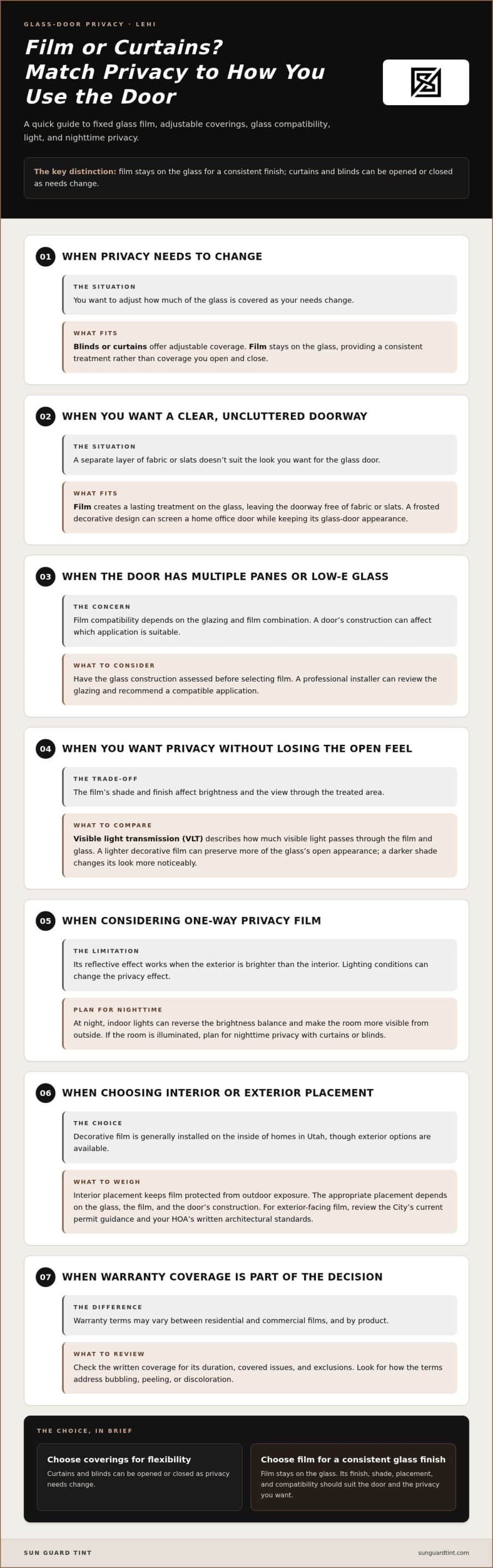
It’s reasonable to compare film with curtains: curtains can be drawn aside, while film stays on the glass for a consistent finish. The right choice depends on your privacy needs and preferred appearance. This guide compares film with curtains, explains where it can be applied and which styles suit glass doors and nearby surfaces, and outlines installation in Lehi. You’ll also learn what to expect as the film is fitted and settles, helping you make a considered choice for your home or business.
Key Takeaways
- Compare fixed glass film with adjustable curtains and blinds to decide which approach best suits your privacy needs.
- Consider how interior or exterior placement can affect the look of the glass, natural light, and views.
- Understand the factors that shape installation timing and what to expect as film settles after fitting.
- Explore how finishes, colors, patterns, and logos can complement your home or business.
- Identify how sliding doors and other glass surfaces can benefit from a tailored film application.
Why Window Film Rather Than Blinds or Curtains?
Film stays on the glass, while blinds and curtains can be opened or closed as needs change. For a glass door, weigh that difference against your preferred privacy, light, view, and interior style. Residential and commercial window tinting services are available in Utah Valley and Salt Lake Valley, where doors and windows may need different treatments within one property.
Privacy Film Versus Window Coverings
Blinds and curtains offer adjustable coverage, but add a separate layer across the opening. Film creates a lasting treatment on the glass, leaving the doorway free of fabric or slats. For example, a frosted decorative design can screen a home office door without changing how it opens. Choose coverings if you need to adjust privacy often; choose film for a consistent glass finish.
Glass Compatibility
Privacy film does not automatically damage insulated or low-E glass doors. Compatibility depends on the glazing and film combination, so the glass construction should be assessed before selection. This matters for doors with multiple panes or a low-E coating. A professional installer can review the glass and recommend a suitable film application, helping avoid a mismatch that could affect the glazing.
Decorative Film for Doors and Windows
Decorative privacy film can add screening and visual detail to a glass door, sidelight, or interior window. A frosted band across an entry door can reduce direct sightlines while leaving other glass areas untreated. A patterned film can create a distinctive finish for an office partition. Choose coverage based on where people approach the glass and which views you want to soften.
Shade and Visible Light Transmission
Visible light transmission, or VLT, describes how much visible light passes through the film and glass. The shade and finish affect both brightness and the view through the treated area. A lighter decorative film can preserve more of the glass’s open appearance, while a darker shade changes its look more noticeably. Compare the intended finish with the door’s location and the room’s natural light.
Residential and Commercial Warranty Considerations
Warranty terms may differ between residential and commercial films, and by product. Review the written coverage for its duration, covered issues, and exclusions before choosing a film. For instance, check how the terms address bubbling, peeling, or discoloration. Clear warranty details help you understand what protection applies to a home entry door versus an office glass partition.
Local Window Tinting and Installation
For a Lehi glass door, consider its glazing, desired privacy, and preferred appearance together. These details also help distinguish a residential project from a commercial application. The window tinting service area includes Utah properties where film can provide a finished treatment for glass doors and windows.
Professional Installation
A professional installer can assess the glass, select a compatible film, and fit it to the door’s dimensions. This is especially useful for doors with multiple panes, narrow edges, or decorative patterns that require careful alignment. For example, a pattern that crosses a door and sidelight needs coordinated placement. Professional installation also avoids turning a high-visibility entry into a trial-and-error project.
Is decorative window film applied on the interior or exterior?
Decorative window film is generally installed on the inside of homes in Utah, though exterior options are available. Interior placement keeps the film protected from outdoor exposure and can provide privacy without curtains. The best choice depends on the glass, the film, and whether you want to preserve daylight and views through a Lehi door or window.
For exterior-facing film in Lehi, review the City’s current permit guidance and your HOA’s written architectural standards before installation. These requirements may address different aspects of a project, including changes to a home’s exterior appearance. A neutral or lightly patterned design may suit a visible front entry, while a more prominent pattern could change its look.
One-way privacy film doesn’t provide the same privacy in every lighting condition. Its reflective effect works when the exterior is brighter than the interior. At night, indoor lights can reverse that balance, making the room more visible from outside. For a glass door facing a neighbor’s walkway, plan for nighttime privacy with curtains or blinds if the room is illuminated.
Film can soften direct sightlines while keeping a room connected to outdoor light. The finish and visible light transmission determine how bright the glass looks and how clearly you see through it. For example, a translucent decorative pattern can obscure a direct view while still allowing daylight into an entryway. A darker or more opaque design creates greater visual separation but changes the view through the treated area.
Interior installation is the usual choice for residential decorative film in Utah. Exterior film options can suit specific glass or exposure conditions, but placement should match the product and the door’s construction. A professional can assess the glass and recommend an appropriate application. Consider the direction of sunlight, the room’s lighting, and the view you want to retain before choosing a finish.
Maintain decorative film with a soft cloth and water. For chemical cleaners, choose an ammonia-free product and use a soft, clean rag. Gentle cleaning helps protect the finish; abrasive materials can scratch the treated surface. Follow the care instructions provided for the film installed on your door.
If you’re looking to compare film options for a home, explore residential window film and consider how its finish will balance privacy, natural light, and outside views.
Tint installation services in Lehi and Bluffdale
For a glass door in Lehi, installation planning starts with the glass, film choice, and how the door operates. Those details shape the application and the time needed on site.
Interior and Exterior Installation
Decorative film is generally installed on the inside of residential glass in Utah, while exterior options are available. The correct placement depends on the glass and selected film. A professional installer assesses the door’s glazing, edges, and exposure before choosing where to apply it.
For a sliding glass door, the installer also considers how the panels move and where their edges meet. This helps determine how to fit the film neatly without interfering with the door’s operation. Interior installation is the usual residential approach; exterior placement suits particular glass or exposure conditions.
Installation Duration
There isn’t one installation time for every door. The number and size of glass panels, film design, access, and preparation all affect the work. A single uncomplicated door differs from a broad sliding assembly with several panes or adjacent sidelights. These details help establish a realistic project schedule.
Installation involves preparing the glass, fitting the film to its dimensions, and applying it carefully for a smooth finish. Intricate patterns or multiple panels require precise alignment. For privacy tint for glass doors in Lehi, accurate measurements and a clean work area help the installer treat each panel consistently.
Drying continues after the installer finishes. Decorative window film generally takes around 30 days or less to dry fully, as moisture beneath the film evaporates. During this period, the appearance can change as the film settles. Small variations in clarity while it dries are part of the settling process.
After window tint installation, wait 3-5 days before lowering windows so the film can bond. That guidance concerns windows that lower; a sliding glass door operates differently, so avoid treating the instruction as a door-specific rule. Follow the care guidance for the film and glass installed.
Before the appointment, clear access to the door and nearby glass so Sun Guard Tint can work around the full panel. Note whether the project includes sidelights or several sliding panels, and identify which sections need privacy most. These practical details help define the scope and keep the finished treatment aligned with the door’s use.
Film styles, colors, patterns, and custom logos
Privacy film can be chosen for its appearance as well as its screening effect. A Lehi entry door might suit a simple frosted finish, while a conference-room door may call for a defined pattern. The style should fit the building’s architecture, the room’s purpose, and how much of the glass you want to soften.
Frosted film creates a diffused look across treated glass. Clear sections can be left between frosted areas to form horizontal bands or a border. For example, a narrow clear strip across an office door can break up a solid-looking finish while keeping the design restrained. A repeating geometric pattern creates a more structured effect.
Color changes how a glass panel relates to its surroundings. Neutral tones can complement white trim, pale walls, or natural wood, while a stronger color can echo an accent wall or business identity. Compare the film with the door frame and nearby finishes, not only with a small sample. Light passing through the glass can affect how the color appears indoors.
Pattern scale matters on different surfaces. A fine repeating motif may suit a narrow sidelight, while a larger design can read clearly across a wide sliding panel. Aligning repeated shapes across adjoining panes creates a continuous visual rhythm. Use the door’s frame, handles, and panel divisions to guide pattern placement.
Custom logos can combine privacy treatment with brand identification on commercial glass. A business might place its logo at eye level on an office entry or use a repeated mark across a meeting-room partition. Keep important lettering large enough to read from the intended viewing distance. Place the logo with door handles and visible glass borders in mind.
Before settling on a design, compare these details:
- Coverage: Decide whether the film should span the full pane or form a partial band.
- Contrast: Check how the pattern and color stand out against the room and exterior.
- Alignment: Match lines or motifs across adjacent panels where continuity matters.
- Artwork: Use a clean logo file and identify the intended location on the glass.
For a Lehi home, a subtle border may complement an entry without dominating the door. In a Provo office, a logo or repeated motif can distinguish a conference room from nearby work areas. Reviewing the full design against the actual glass helps balance appearance, privacy, and the space’s existing finishes.
Applications for sliding glass doors and other glass surfaces
A sliding glass door presents a larger privacy challenge than a small window because it often spans a patio entrance or living-room wall. Film can be applied to the fixed panel, moving panel, or both. Treating both panels creates a consistent appearance, while treating one can create a defined privacy zone. The right layout depends on the views you want to screen and how you use the door.
Panel alignment matters. A pattern that continues across a sliding door should meet cleanly where the glass panels overlap or separate. For example, a frosted band across both panels can look continuous when the door is closed, but its placement should account for panel movement. A professional installer can assess the glass edges, handles, and frame before planning the layout.
Nearby glass can also be part of the design. A sidelight beside an entry door may expose a direct view into a hallway, while a transom above the door may need a different treatment. Matching finishes across the door and sidelight creates a coordinated entry. Treating only the sidelight keeps the main door clearer while screening the most exposed sightline.
Interior glass partitions offer another useful application. In a home office, a patterned section on a glass divider can define the workspace without making the whole partition look solid. In a commercial meeting room, a frosted strip can add visual separation at seated eye level. Choose coverage to suit the room’s function and how people move past the glass.
Other suitable surfaces include interior office windows and glass panels between shared areas. For each surface, consider its position, surrounding frame, and the view through it. A narrow decorative strip may suit a door near a hallway, while broader coverage may better serve a glass partition beside a reception area. One layout won’t fit every pane.
Before planning a project, note which surfaces need treatment and what each one should accomplish:
- Sliding door: Choose whether the moving panel, fixed panel, or both need film.
- Entry sidelight: Identify the exposed sightline beside the door.
- Interior partition: Decide which areas need visual separation, such as a meeting-room divider.
- Adjacent glass: Compare finishes so connected surfaces look intentional together.
For a home with patio doors and a nearby sidelight, mapping each pane helps create a coordinated result without treating every surface identically. Explore residential window film options to consider how a glass-door project can suit the surrounding windows and interior.
Sun Guard Tint: Residential Window Tinting
Sun Guard Tint provides Residential Window Tinting for homeowners considering privacy film on glass doors, entry sidelights, or other home windows. For a Lehi project, the glass type, door layout, desired privacy, and preferred finish help shape the right film approach. For workplace glass, Commercial Window Tinting may suit offices or other business spaces. Smart Window Film is another option when it fits your needs.
Turn to Sun Guard Tint when you’re ready to discuss a specific glass surface and how film could fit its use and appearance. Sharing which panes you want treated and the look you prefer gives the conversation a clear starting point. Contact Sun Guard Tint to discuss your window tinting project.
Shape a More Private, Light-Filled Space
Start by defining what you want the glass to do in everyday use. Consider where passersby can see inside, which areas should remain bright, and how the door connects with nearby rooms. Those priorities give your project direction before you settle on a finish. They also turn privacy tint for glass doors in Lehi from a broad idea into a considered choice for your home.
Think beyond the door itself. The surrounding entry, adjacent windows, and interior style all influence whether the finished treatment feels seamless or distinctive. A clear sense of your priorities makes it easier to discuss the right approach for the glass and the space.
Ready to explore a film solution for your property? Connect with Sun Guard Tint to discuss your project and take the next step toward a more comfortable, thoughtfully finished space.
Frequently Asked Questions
How long does an install take?
Most residential and commercial window film projects can be completed in just a few hours. Complex projects may take up to a day. Projects with several glass doors or detailed layouts may need more installation time than a single straightforward panel. Scheduling around room access and moving furniture away from the work area can help the installation proceed smoothly.
Will the tint bubble, peel, or turn purple?
Professional-grade film is designed to resist bubbling, peeling, and discoloration. Sun Guard Tint films resist these issues, but no film is immune to damage. For example, scraping the surface with a sharp object can harm the finish. Choose professional installation and follow the film’s care guidance to help preserve its appearance.
What types of privacy window film work best for glass doors?
The best film depends on how the doorway is used and what you want visible through the glass. Frosted film suits a bathroom or entry where a consistently screened look matters. A decorative option can add pattern to a home office door. If maintaining a view is important, compare privacy films carefully and account for lighting conditions.
What is the difference between frosted, decorative, and one-way privacy film?
Frosted film gives glass a diffused, screened appearance. Decorative film adds designs, such as geometric patterns or borders, and can also obscure views. One-way film creates a reflective effect under the right lighting conditions, but doesn’t provide dependable privacy in every situation. For a street-facing entry, choose based on whether consistent screening, a design feature, or a reflective look matters most.
How much does privacy tint for glass doors cost in Lehi, Utah?
The price depends on the project and is provided after a quote request. Key factors include the size and number of glass panels, film type, design, and installation complexity. A single clear panel and a multi-panel sliding door with a detailed pattern involve different work. Share which doors you want treated and your preferred finish when requesting a quote.
Which companies install privacy window film in Lehi, Utah?
Sun Guard Tint installs residential window film for homeowners in Lehi. When comparing options, focus on whether the installer handles the type of glass and application you need, such as an entry door or patio slider. Sun Guard Tint also serves West Jordan, Salt Lake City, Provo, Orem, Payson, Spanish Fork, South Jordan, and Saratoga Springs.
Can privacy film be installed on sliding glass doors and entry doors?
Yes, privacy film can be installed on sliding glass doors and entry doors. On a slider, the installer needs to account for the meeting edges and handles so the film doesn’t interfere with movement. An entry door with sidelights may need a coordinated layout across several panes. Discuss how the door opens and which panels need coverage before selecting the installation plan.
How durable is privacy film on frequently used glass doors?
High-quality window film can last upwards of 10-20 years. On a frequently used door, durability also depends on selecting film suited to the glass and avoiding direct abrasion during everyday use. For example, rings, keys, or hard objects can scratch a treated surface. If the film becomes worn or you want a new look, a professional installer can remove or replace it without damaging the windows.

Article by
Sun Guard Tint