

Graffiti cleanup doesn’t always require replacing glass. Anti-vandalism film for public property in Salt Lake City adds a clear, replaceable layer over vulnerable surfaces. Spray paint, scratches, or etching can damage the film instead of the glass beneath it. If the film is damaged, it can be removed and replaced.
For public-facing windows, mirrors, and other smooth surfaces, a protective layer can help preserve the existing appearance. Anti-graffiti film won’t prevent vandalism or reverse etching already in the glass, but it can make some damage easier to address without replacing the entire pane.
This article explains how the film works, which surfaces and properties it can protect, and what to consider for a Salt Lake City installation. You’ll also learn how professional installation fits into a broader plan for preserving public property and keeping damaged surfaces looking presentable.
Key Takeaways
- Learn how sacrificial film creates a replaceable protective layer over glass and other smooth surfaces.
- See which kinds of surface damage anti-graffiti film is designed to resist, and where it may be used on public property.
- Understand why existing etching and damage require a different approach than preventing future surface damage.
- Explore how surface type and installation placement shape a professional film application.
- Find out what to consider when planning protection for public-facing properties in the Salt Lake City area.
What Is Anti-graffiti Window Film?
Anti-graffiti window film is a thin, optically clear polyester laminate applied to the interior or exterior of glass. It creates a sacrificial surface between the window and vandalism. Spray paint, marker, scratches, and etching can damage the film instead of directly marking the glass. While intact, the transparent layer helps preserve the window’s appearance. For managers considering anti-vandalism film for public property in Salt Lake City, its replaceable surface is the main practical benefit.
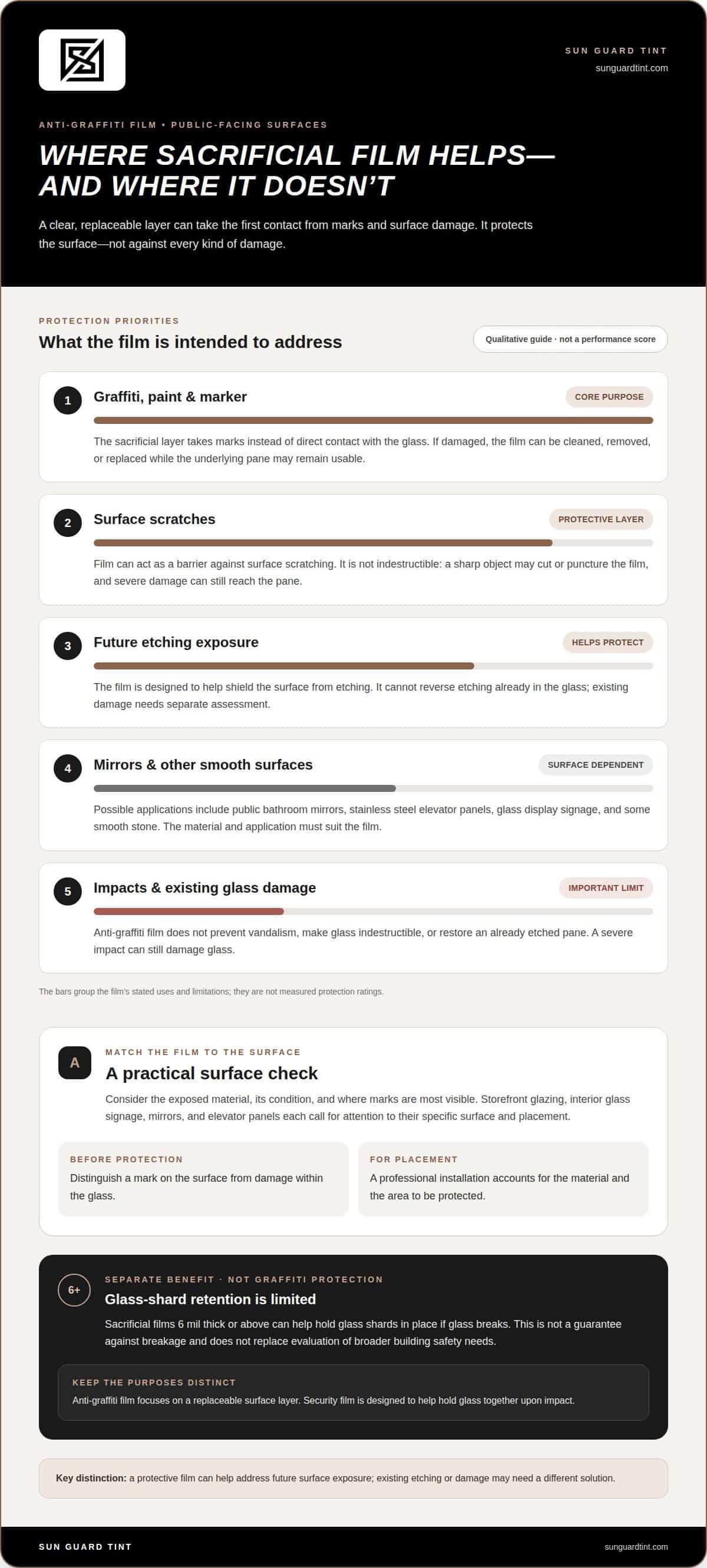
“Sacrificial” describes what happens after damage: the affected film can be cleaned or removed and replaced, leaving the underlying pane available for continued use if it hasn’t also been damaged. This avoids replacing the entire pane when the glass remains usable. The film doesn’t prevent vandalism or reverse etching already in the glass. It provides a replaceable layer to help address future damage.
Clear anti-graffiti film can protect glass without functioning as a window tint. Tint changes a window’s appearance or light transmission, while anti-graffiti film is intended to shield the surface and remain optically clear. For example, a storefront can retain its existing look while the film takes the first contact from scratches or tagging. Its clarity helps preserve visibility through public-facing glass.
Glass isn’t the only possible surface. Anti-graffiti film can also be used on mirrors, stainless steel elevator panels, and other smooth surfaces. Public bathroom mirrors and elevator panels are practical examples because both present broad, exposed areas that can be marked. Smooth stone may also be considered, but the surface and application must suit the film. Results on glass shouldn’t be assumed for every material.
Existing etching needs particular attention. If acid or another abrasive method has etched a pane, applying clear film won’t restore the original glass. A professional assessment can distinguish a mark on the surface from damage within the glass. That distinction helps property owners determine whether a protective layer can address future exposure or whether the existing pane needs a separate solution.
The Wasatch Fault also makes it useful to understand the difference between surface protection and glass retention. The University of Utah Seismograph Stations identifies the Wasatch Fault as capable of generating earthquakes of magnitude 7.0+. Sacrificial films 6 mil thick or above can help hold glass shards in place if glass breaks. This is a limited benefit, not a guarantee against breakage or a substitute for evaluating a building’s broader safety needs.
For public properties, start by identifying the exposed material and its condition. Clear film may suit a glazed entrance, while a mirror or elevator panel requires attention to its specific surface. For anti-vandalism film for public property in Salt Lake City, matching the application to the surface helps preserve its finish and makes future cleanup or film replacement more manageable.
Protection against graffiti, scratches, and etching
On a public-facing storefront, graffiti can quickly become a visible maintenance problem. An anti-graffiti layer gives paint, permanent marker, and other marks a sacrificial surface instead of direct access to the glass. This can help where repeated tagging affects a building’s appearance, including exposed commercial windows and public-facing display areas.
Scratches and gouges require a different consideration from removable paint. Film can act as a barrier against surface scratching, but it doesn’t make glass indestructible. A sharp object may cut or puncture the film, and a severe impact can still damage the pane. Its value is as a replaceable surface layer, not as a guarantee that every mark or impact will stop at the film.
Acid etching can damage the glass itself rather than just a removable surface. Film is designed to help protect against etching, but it can’t reverse marks already etched into a pane. For a civic building with etched windows, this distinction matters: film can help address future exposure, while the existing damage needs separate assessment.
Mirrors are another practical application. A public restroom mirror, for example, may be exposed to marker, scratches, and wear from cleaning. A protective layer gives the mirror’s face a sacrificial barrier that can be addressed if damaged. The same principle applies to glass display signage, where a clear surface helps keep lettering and graphics visible while limiting direct contact with the glass.
Commercial properties can use film selectively rather than treating every surface alike. A storefront may prioritize street-level glazing, while a public facility may have exposed mirrors or interior glass signage. Focus on areas where graffiti or scratches are visible to visitors and replacing a whole component would disrupt its use. Professional installation accounts for the surface and the area to be protected.
Stainless steel elevator panels show how this approach can extend beyond glass. A smooth metal panel can receive a protective layer, but film isn’t a general corrosion treatment or a repair for damaged metal. If a property has metal, glass, and mirror surfaces, matching the application to each material keeps protection focused and avoids treating unlike surfaces as interchangeable.
Security film serves a different purpose from sacrificial anti-graffiti film. Security film is designed to help hold glass together upon impact; graffiti protection focuses on a replaceable outer surface. Building managers considering both concerns should distinguish each film’s purpose before choosing an application. The right fit depends on whether the priority is surface marking, glass behavior after impact, or both.
For properties where visible tagging repeatedly affects glass or signage, professional graffiti protection film can provide a targeted surface layer. The film helps make future cleanup or replacement more manageable, while preserving the underlying surface when damage remains confined to the protective layer.
Anti-graffiti surface films for Salt Lake City commercial properties
Salt Lake City properties can use surface film to protect exposed glazing and other smooth areas from tagging. The best applications depend on which surfaces face repeated contact and what type of damage owners need to address.
Suitable Properties and Locations
Street-facing windows at Salt Lake City businesses are natural candidates when graffiti regularly affects their appearance. Public transportation facilities, including buses, trains, and subway stations, also have exposed surfaces that may benefit from protective film. Schools and university buildings in areas prone to vandalism are other examples. The same approach can be considered for elevator panels, escalators, and mirrors in malls or office buildings.
Start by identifying the specific surfaces that need protection, such as an entrance window, a lobby mirror, or a display panel. Film suitability depends on the material and its condition. Glass, metal, and mirrors have different characteristics, so don’t assume one application will work identically on every surface.
Film Thickness and Performance
Sacrificial anti-graffiti film used in Salt Lake City commercial applications is typically 2-4 mil thick. This layer is intended to take surface damage before the underlying glass does. If graffiti or scratches damage the film, a professional can remove and replace it. The film’s purpose is surface protection, not a guarantee against all damage or a way to restore glass already etched.
Some anti-graffiti films block up to 99% of UV rays, which can add a separate benefit for certain applications. That figure applies to some films, not every product. For a storefront, owners should consider the main concern first: graffiti, scratching, sunlight exposure, or a combination. Matching the film’s intended performance to the site helps avoid choosing by thickness alone.
Combining Safety and Anti-Graffiti Films
Some properties need both a cleanable sacrificial surface and help holding glass together after impact. Clear safety and security film is designed to hold glass in place upon impact, while anti-graffiti film addresses marking and scratching. These functions aren’t interchangeable. The right combination depends on the exposed glazing, the surface-protection goal, and whether glass behavior after impact is also a concern.
Film type and placement matter. A professional can assess the glazing and select an application suited to the property, rather than treating every window alike. For example, a public entrance may need surface protection as well as separate consideration of security, while a display window may chiefly need protection from graffiti.
Comparing Security Film Options
Security film is applied to existing glass and is designed to help hold it together upon impact. Laminated glass uses a different glass construction, while shutters create a physical barrier and anti-graffiti coatings target surface marking. These options serve different purposes, so choose according to the property’s priorities. Security film doesn’t guarantee that glass won’t break, and broken glass can still present a hazard.
For a business in Salt Lake City, compare options according to the specific need rather than treating them as equivalents. Film may suit existing glazing when retaining the current window is important; shutters may suit a property seeking a physical cover. An anti-graffiti layer addresses surface damage, not every security concern. A professional assessment can clarify the applications needed and the limits of each approach.
Security film installation in Salt Lake City, Utah
Professional installation places film over existing windows, with the process tailored to the glass, surface condition, and property use. For Salt Lake City venues, scheduling also depends on the number and type of windows involved.
Surface Preparation and Installation Steps
Professional installation begins with assessing the existing glass and identifying the surfaces included in the project. The installer prepares each window before fitting film because dust or residue can affect the finished surface. Film is then measured and applied to the existing glazing. This is a professional service, not a do-it-yourself task.
Most standard retail windows take 20-45 minutes each for anti-graffiti film application. After installation, the film reaches full adhesion within 24-48 hours. During that period, property managers should follow the installer’s care guidance for the specific film and surface. Tinting and window tinting may use similar installation methods, but the film’s purpose determines the product selection.
Building Rules and Permit Considerations
Public-building requirements and permit needs depend on the property authority and the project’s scope. Applying film over existing windows is different from work that changes the building structure, but that distinction alone doesn’t establish every approval requirement. For a Salt Lake City civic building, relevant considerations include the property’s governing authority, the glazing involved, and the planned work.
There is no single permit answer for every commercial or public property. The responsible building authority determines which approvals apply to its site and project. This is particularly relevant for venues with managed facilities, where planning may involve building operations as well as the installation area.
Assessment and Installation Quotes
A property manager can request a professional assessment and quote by sharing the site location, window count, glass types, and areas needing protection. Photos of the glazing and existing damage, such as tagging on entrance windows, help describe the work. The assessment can then account for the surfaces, coverage, and intended film function.
For a public venue, include access conditions and any scheduling constraints in the request. A commercial installation covering up to 20-30 window panels can usually be completed in a single day. An arena or convention center security-film installation typically requires 3-7 days, reflecting a larger project scope. Request an installation assessment from Sun Guard Tint with these project details to begin planning.
Service coverage in Salt Lake County
For public property managers, “coverage” can mean the area receiving film, not just a map boundary. In Salt Lake County, a project might focus on one street-facing entrance or several exposed surfaces across a facility. Define the site and surfaces first. This makes the installation scope clearer than treating every window, mirror, and panel alike.
Properties in Salt Lake City can begin with a practical site review. Identify windows and smooth surfaces facing public walkways, entrances, transit areas, or shared interiors. A library entrance, for example, may have different priorities from an elevator lobby. Record which surfaces need protection and whether the goal is to preserve appearance, make damaged film replaceable, or address multiple needs.
County geography helps organize a project, but a city name alone doesn’t determine which surfaces need film. A facility in West Jordan and a public building in Salt Lake City may have different layouts, glass types, and access needs. For either property, start with a site-specific list of surfaces, clearly identifying the address and project area.
Optically clear film is designed to preserve a window’s appearance, but it isn’t literally invisible in every condition. The glass, lighting, edges, and installation quality all affect how the finished surface looks. A professional assessment can account for those details, particularly where a public entrance or display needs to retain a clean appearance. Film helps protect surfaces; it doesn’t prevent vandalism.
Property managers in Salt Lake County can also plan coverage in phases. A facility might prioritize its most exposed entrance before considering interior mirrors or other smooth panels. This keeps the protection plan tied to actual surfaces and their uses. If damaged film is removed and replaced, the underlying glass can remain in service when it hasn’t also been damaged.
To prepare an installation plan, list the property address, areas of concern, and surfaces involved. Add examples such as tagged entrance glass, scratched lobby panels, or exposed display windows. These details help shape an assessment around the property’s actual layout rather than a general county-wide assumption. They also clarify whether the project covers one area or several.
The key takeaway for Salt Lake County properties is to define coverage by site and surface. The address establishes the location; the building’s exposed windows and panels establish the work area. For a Salt Lake City property, request an installation assessment to discuss the surfaces and project scope.
Sun Guard Tint
Sun Guard Tint helps property managers in Salt Lake City and nearby communities protect exposed glass and smooth surfaces with professionally installed film. For public-facing windows affected by tagging or scratching, Graffiti Protection Film provides a replaceable surface layer. The underlying glass can remain in use if it is undamaged. The right application depends on the property’s surfaces and protection goals.
For broader building needs, Sun Guard Tint also offers commercial and residential window tinting and Smart Window Film. If you’re planning protection for a public property, share the location and areas of concern to discuss an appropriate installation. Contact Sun Guard Tint to talk through your project.
Plan Your Property’s Next Layer of Protection
Choosing anti-vandalism film for public property in Salt Lake City begins by defining the property’s main need: preserving the appearance of exposed surfaces, improving comfort, or supporting a broader window plan. A clear project scope helps connect the film choice to the building’s use, glazing, and the areas most important to protect.
Sun Guard Tint offers Residential Window Tinting, Commercial Window Tinting, and Smart Window Film alongside graffiti protection. These options support different property goals, from protecting vulnerable public-facing glass to considering window film across a larger facility. Start by discussing the property and the outcome you want from the film installation.
Discuss a film plan with Sun Guard Tint and take the next step toward a considered approach to protecting your property.
Frequently Asked Questions
What is anti-vandalism security film and how does it protect glass?
Anti-vandalism film is a protective layer applied to glass, and its function depends on the film type. Anti-graffiti film provides a sacrificial surface that can be removed after tagging or scratches, while safety and security film is designed to help hold glass in place upon impact. A public library entrance exposed to marker damage has different needs from glazing selected to help retain glass fragments. Neither type guarantees that glass won’t break.
What types and thicknesses of security film are best for public buildings?
The best film depends on the building’s main concern: surface vandalism, impact, or both. Security film is described in standard thicknesses of 4-8 mil, while sacrificial anti-graffiti film serves surface protection. Thickness alone doesn’t determine suitability; the glass, installation, and intended function also matter. For example, a transit facility may need to distinguish protection against tagging from a separate goal of helping hold glass together after impact.
What are the best security film installers in Salt Lake City, Utah?
Sun Guard Tint professionally installs film for properties seeking graffiti protection or safety and security protection. Service locations include Salt Lake City, West Jordan, South Jordan, Provo, Orem, Lehi, Payson, Spanish Fork, and Saratoga Springs. To discuss a public building project, share the site, glazing, and protection goal, whether the property is a storefront, school, office, or another facility.
How long does security film last, and what maintenance or warranty is typical?
High-quality window film can last upwards of 10-20 years. Actual service life depends on the film type and conditions. Maintenance and warranty coverage are tied to the specific film and installation terms, so the applicable product documentation is the best guide for care and coverage. For instance, a public entrance exposed to frequent contact may need different attention from office glazing with limited direct handling.

Article by
Sun Guard Tint