

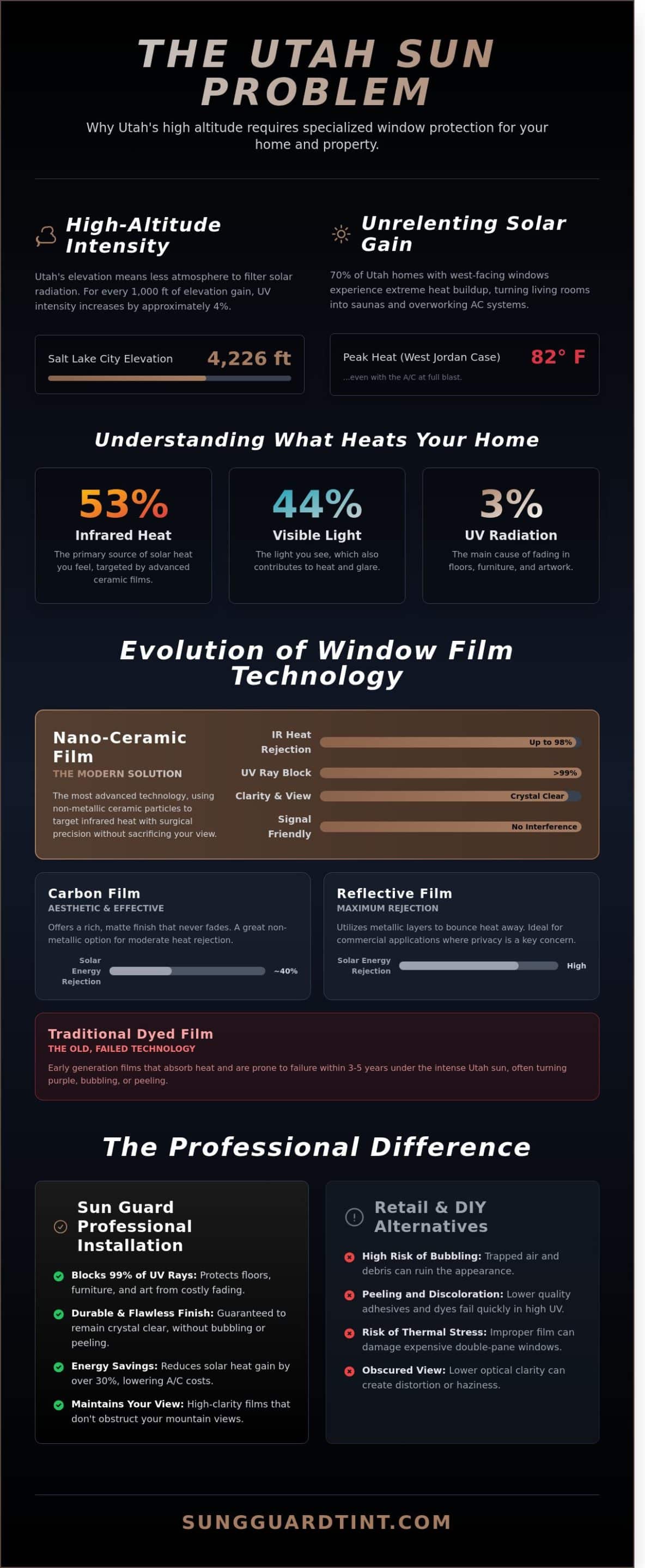
On July 15, 2023, a West Jordan homeowner watched their indoor thermostat climb to 82 degrees despite the air conditioning running at full capacity. Like 70% of Utah residents with west-facing windows, they struggled with a living room that felt more like a sauna than a sanctuary. You likely agree that it’s frustrating to hide behind heavy curtains just to stay cool, especially when it means sacrificing those iconic Wasatch Mountain views. By choosing a professional heat reducing window film, you can maintain your connection to the outdoors while shielding your family from the intense high-altitude sun.
We promise to show you exactly how this high-performance technology transforms local properties by slashing indoor temperatures and preserving expensive hardwood floors from the 99% of UV rays that cause permanent fading. This case study details a recent project where we helped a Salt Lake City client reduce their solar heat gain by 30% in a single month. You’ll see the technical breakdown of how our Expert Guardian approach provides long-term protection and energy savings for your home or office.
Key Takeaways
- Understand why Utah’s unique high-altitude elevation requires specialized solar protection to effectively manage intense interior heat.
- Compare the evolution of film technology, from traditional dyed options to premium nano-ceramics, to identify the best solution for your cooling needs.
- Explore a West Jordan case study where professional heat reducing window film successfully lowered internal temperatures and stabilized the home’s climate.
- Learn how to protect your property by blocking 99% of UV rays, preventing the costly fading of hardwood floors and luxury rugs.
- Discover the critical performance differences between professional-grade installations and retail alternatives to ensure your windows remain crystal clear and peel-free.
The Science of Heat Reducing Window Film in Utah’s High-Altitude Climate
Heat reducing window film is a sophisticated multi-layered polyester coating engineered to manage solar energy before it enters your living space. In Utah, where Salt Lake City sits at an average elevation of 4,226 feet, this technology is a necessity rather than a luxury. Atmospheric density decreases at higher altitudes, meaning there’s less air to filter out intense solar radiation. For every 1,000 feet of elevation gain, UV levels increase by approximately 4 percent. This makes solar heat rejection in the Intermountain West significantly more critical than in coastal regions at sea level.
Understanding the metrics is vital for a smart investment. Visible Light Transmission (VLT) measures the amount of light that passes through the glass, while Total Solar Energy Rejected (TSER) tracks the percentage of solar energy, including infrared, UV, and visible light, that the film deflects. Most modern Salt Lake City homes utilize double-pane glass. Our films are specifically designed to work with these sealed units, reflecting heat outward without creating the thermal stress that can lead to seal failure in lesser products. We ensure every installation meets the Sun Guard Tint standard of quality for long-term durability.
Understanding Infrared Heat vs. Visible Light
Heat isn’t just about brightness. Infrared rays account for 53 percent of the solar energy that heats your home, while visible light accounts for only 44 percent. Advanced heat reducing window film utilizes nano-ceramic technology to target these specific infrared wavelengths. This allows you to maintain high optical clarity while blocking up to 98 percent of infrared heat. Protecting your interior also involves managing the 3 percent of solar energy that is pure UV radiation. This invisible spectrum is the primary driver of “solar gain” and interior heat buildup during the peak of summer.
The Impact of the Intermountain West Sun
West-facing windows in Utah face a unique challenge during summer afternoons between 3:00 PM and 7:00 PM. During these hours, the sun’s angle is direct, and the thinner mountain atmosphere offers little protection. High-altitude UV rays are responsible for 40 percent of the fading found on hardwood floors and furniture. As your Expert Guardian, we focus on shielding properties from this extreme mountain weather. Professional residential window film provides a durable barrier that stabilizes indoor temperatures even when the external environment is harsh. You’ll experience the difference in comfort immediately after the application is complete.
Choosing the right protection requires a balance of aesthetics and functionality. Modern films don’t have to be dark or reflective to be effective. By selecting a high-TSER film, you’re investing in a solution that keeps your views crystal clear while significantly reducing the load on your HVAC system. It’s a meticulous approach to property maintenance that pays dividends in both comfort and energy savings. Our team takes pride in providing this level of technical expertise to every client we serve.
Performance Comparison: Ceramic vs. Reflective vs. Carbon Films
Window film technology has undergone a massive transformation since the early 1990s. Early dyed films often failed within three years, turning purple or bubbling under the intense high-altitude sun found in Salt Lake City and Park City. Today, the industry has shifted toward advanced materials like carbon and nano-ceramics that prioritize molecular stability. Choosing the right heat reducing window film depends on your specific goals for light transmission, privacy, and thermal performance. Before making your decision, it’s worth understanding the common misconceptions surrounding these products — our guide to heat rejection window film myths for Utah properties can help you separate fact from fiction.
- Carbon Films: These offer a rich, matte finish that never fades. They typically reject about 40% of solar energy and provide a sleek aesthetic without any metallic shine.
- Reflective Films: Utilizing thin layers of metal, these films are highly effective at bouncing heat away from the glass. They are ideal for spaces where maximum solar rejection is the only priority.
- Ceramic Films: This is the most advanced option available. It uses non-conductive, non-metallic particles to filter the solar spectrum with surgical precision.
Utah’s climate is notoriously harsh on building materials. Temperatures can swing from -10°F in January to over 105°F in July. This thermal expansion and contraction can cause inferior films to peel or crack. High-performance films are engineered to maintain their bond to the glass across these extremes, ensuring your investment remains intact for decades rather than seasons.
Nano-Ceramic: The Gold Standard for Utah Properties
Ceramic films are the premier choice for modern architecture. Unlike metallic films, they do not interfere with cell signals or Wi-Fi. They provide an incredible 99% UV protection and block over 90% of infrared heat. This allows you to enjoy the full beauty of the Wasatch Range through crystal-clear glass while keeping your interior significantly cooler. For those seeking the highest level of protection, ceramic window tint for homes offers a near-invisible shield that outperforms almost every other category on the market.
Reflective and Dual-Reflective Options
Reflective films are often the best solution for commercial storefronts or western-facing bedrooms where privacy is a major concern. However, traditional reflective films can create a “mirror effect” at night, making it difficult to see outside when your interior lights are on. Dual-reflective technology solves this by using a different coating on the interior side. This maintains your privacy during the day but allows for clear views after sunset. Many homeowners choose this type of residential window film to balance high heat rejection with functional nighttime visibility. If you aren’t sure which technology fits your glass type, you can request a professional consultation to see these materials in person.
Case Study: Reducing Interior Temperatures in a West Jordan Residence
A residential property in West Jordan, Utah, serves as a perfect example of how the right technology solves local climate challenges. This 2,800 square foot home, built in 2012, featured expansive west-facing windows that transformed the main living area into a heat trap every afternoon. By 3:30 PM, internal temperatures frequently climbed to 84 degrees, forcing the HVAC system to run at maximum capacity until well after sunset. The homeowners were caught in a cycle of high utility costs and persistent physical discomfort.
The Challenge: Combatting the Afternoon “Hot Zone”
Many Salt Lake County residents face the reality of rooms that remain uncomfortably warm until 10 PM. In this specific West Jordan case, the solar heat gain was so intense that it caused 18% visible fading on the homeowner’s cherry wood flooring over just two summers. The family also struggled with intense glare that made television viewing nearly impossible during the evening. Because they lived in a community with strict HOA guidelines, they couldn’t use dark or highly reflective products. They required a solution that provided protection without altering the home’s exterior aesthetic or blocking their views of the Oquirrh Mountains.
The Solution: Professional Grade Heat Shielding
The homeowners bypassed temporary retail solutions in favor of a specialized ceramic heat reducing window film. While big-box DIY kits often offer lower optical clarity and a limited lifespan, our professional-grade ceramic films utilize nano-technology to block infrared light while remaining virtually invisible. Our team performed a meticulous multi-stage cleaning and application process to ensure the film bonded perfectly to the glass. This precision prevents the bubbling and edge-peeling common in non-professional applications. You can view the aesthetic results of similar high-end installations in our online gallery.
Measurable Outcomes and Energy Efficiency
The results were immediate and quantifiable. Within 48 hours of the installation, the peak interior temperature in the living room dropped from 84 degrees to a consistent 75 degrees. Data from the home’s smart thermostat showed that the air conditioning unit cycled 26% less frequently during the 4 PM to 8 PM window. This reduction in mechanical strain doesn’t just lower monthly utility costs; it also adds years to the lifespan of expensive HVAC equipment. Beyond the numbers, the family regained the use of their primary living space during the most beautiful hours of the day.
Professional window film acts as a thermal barrier that pays for itself through reduced mechanical strain and energy savings. It’s a strategic upgrade that turns a vulnerability into a long-term asset for any Utah property owner.
Beyond Heat: UV Protection and Glare Reduction for Utah Homeowners
While lowering your cooling costs is a primary goal, heat reducing window film provides a comprehensive defensive layer for your property. It functions as an invisible barrier, filtering out 99% of the sun’s destructive ultraviolet rays. This protection is essential for your family’s skin health and the longevity of your interior design. Beyond radiation, these films enhance physical safety. The adhesive bond provides a degree of shatter-resistance, keeping glass fragments intact if a window breaks. This simple addition transforms standard glass into a high-performance safety feature that guards against accidental impacts and potential break-ins.
Protecting Interiors in the Salt Lake Valley
The Salt Lake Valley’s high altitude increases UV exposure by approximately 10% for every 1,000 feet of elevation. This means your furniture and flooring face an aggressive environment that causes materials to become brittle and colors to wash out. Replacing a sun-damaged designer sofa or a custom-fitted rug is a significant expense that most homeowners want to avoid. Protecting these assets is a smart financial move that pays for itself by extending the life of your decor. This protective standard isn’t limited to homes. Many local business owners install commercial window film to shield their retail displays and inventory from the same harsh Utah sun, ensuring products look their best for customers.
Optimizing the Home Office Environment
Since the shift toward remote work accelerated in 2020, over 30% of professionals in Lehi and South Jordan now work from home at least part-time. Glare on your screen is a major hurdle for productivity. It causes squinting and headaches, which often lead to mid-afternoon fatigue. A professional heat reducing window film cuts this glare without sacrificing natural light. You’ll gain a clear, crisp view of your screen and the outdoors simultaneously. For those who need to separate their workspace from the rest of the home or enhance privacy during video calls, interior office tinting offers an elegant solution for glass doors and partitions. It creates a refined, focused environment where you can perform your best work without the distraction of shifting sunlight.
Experience the peace of mind that comes with a protected home by requesting your free quote today.
The Sun Guard Standard: Why Professional Installation Matters
Investing in property protection requires more than just buying a product. It involves a partnership with specialists who understand the science of solar control. While high-quality heat reducing window film acts as a shield against 99% of harmful UV rays, its performance depends entirely on the precision of the application. A professional installation ensures that the film’s technical properties, such as infrared rejection and optical clarity, remain intact for years to come.
Utah’s environment presents unique challenges for window treatments. The high altitude increases UV intensity by roughly 10% for every 1,000 feet of elevation. This means a home in the Salt Lake Valley faces a more aggressive solar load than a property at sea level. Our team approaches every project with the mindset of an Expert Guardian. We don’t just apply a tint; we secure your investment against the harsh mountain sun.
Avoiding the Pitfalls of Retail DIY Films
Retail-store alternatives often rely on low-grade, pressure-sensitive adhesives that struggle in extreme temperatures. In Utah, where summer heat regularly climbs above 100 degrees Fahrenheit, these adhesives often fail within the first 12 to 18 months. This leads to unsightly bubbling, “fingering” at the edges, or a complete loss of adhesion. Professional-grade ceramic films utilize advanced chemical bonding agents designed to withstand these thermal shifts without degrading.
Achieving a flawless finish requires a controlled, dust-free environment and specialized tools that most homeowners don’t have in their garage. A single speck of dust trapped under the film can create a permanent blemish and reduce the film’s lifespan. Our technicians use a meticulous multi-step cleaning process to ensure the glass is surgically clean before the film ever touches it. We focus on providing a friendly, informative consultation so you understand exactly how our professional tools and techniques provide a superior result compared to a weekend project.
Experience the Sun Guard Difference
We’ve served the West Jordan community for over 22 years. This local experience is vital because we’ve seen how different glass types react to the Salt Lake Valley’s seasonal swings. A precision-fit installation is the only way to prevent edge-peeling. We cut every piece of heat reducing window film to the exact specifications of your window frame, leaving no gaps for light or heat to leak through.
Longevity and craftsmanship are the pillars of our service. Unlike retail kits that offer limited or non-existent support, our professional installations come with a robust warranty. This gives you peace of mind knowing that your 80% infrared heat rejection will remain consistent for a decade or more. We take pride in the meticulous details, ensuring that every corner is tucked and every edge is seamless. Ready to transform your home or office? You can contact us today for a custom property assessment. Let’s work together to protect what matters most with a solution built to last.
Secure Your Property With Next-Generation Protection
Investing in your property means choosing solutions that stand up to Utah’s intense high-altitude sunlight. Our West Jordan case study proved that specialized High-TSER nano-ceramic technology outperforms traditional options by targeting infrared heat at the source. This advanced heat reducing window film doesn’t just lower interior temperatures; it shields your furniture and skin from 99% of harmful UV rays while preserving crystal clear optical clarity.
With over 20 years of local Utah experience, Sun Guard Tint understands the specific environmental challenges of the Salt Lake Valley. We’ve spent two decades perfecting our Expert Guardian service to ensure every installation meets a rigorous standard of durability. As a locally owned and operated specialist, we prioritize high-performance materials that provide long-term comfort and energy efficiency for your home or office. It’s a transformative upgrade that balances premium aesthetics with technical excellence.
We look forward to helping you create a cooler and more comfortable environment today.
Frequently Asked Questions
Does heat reducing window film really work in Utah?
Yes, heat reducing window film is highly effective in Utah’s high altitude climate where solar radiation is 15% more intense than at sea level. Our premium films block up to 80% of solar heat before it enters your home. This reduces the load on your HVAC system by 30% during July peaks. You’ll notice a cooling effect immediately after our professional installation.
Will heat control film make my home too dark inside?
No, you don’t have to sacrifice natural light for comfort. Modern ceramic films offer a Visible Light Transmission (VLT) of 70% or higher, which means they’re virtually invisible to the naked eye. You enjoy 99% UV protection while maintaining the crystal clear views of the Wasatch Range. It’s a high performance shield that preserves your home’s aesthetic.
How much heat can window film actually block?
Professional grade heat reducing window film can reject up to 84% of total solar energy. This technology targets infrared light, which is responsible for 50% of the heat you feel on your skin. By filtering these specific wavelengths, the film keeps interior surfaces 15 degrees cooler. It transforms your windows into high performance barriers against the summer sun.
Can I install heat reducing film on double-pane windows?
Yes, you can safely apply heat reducing film to double-pane windows if you select a product rated for dual-pane systems. We use specialized films designed to prevent thermal stress, which can cause glass breakage if the wrong material is used. Our technicians ensure the film’s absorption rate stays below 35% to protect the integrity of your seals. This professional match ensures long term safety and performance.
Will window film stop my furniture and floors from fading?
Window film slows fading by blocking 99% of ultraviolet rays, which cause 40% of interior damage. While nothing stops fading entirely, our films also address solar heat and visible light, the other two contributors to sun damage. This protection extends the life of your hardwood floors and leather sofas by 3 to 5 times. It’s a vital investment for south facing rooms.
How long does professional window film last in the SLC climate?
A professional installation in Salt Lake City typically lasts 15 to 20 years. Our high end films are manufactured with advanced adhesives and scratch resistant coatings to withstand Utah’s temperature swings from 0 to 100 degrees. We provide a lifetime residential warranty that covers bubbling, peeling, and delamination. You can trust this shield to perform year after year without losing its optical clarity.
Does window film help with energy bills during Utah winters?
Yes, specific Low-E window films improve your home’s insulation by up to 10% during the winter months. These films reflect interior radiant heat back into your living space instead of letting it escape through the glass. This dual season performance helps stabilize your indoor temperature 365 days a year. You’ll see lower heating costs when the snow starts falling in the valley.
Is there a difference between automotive and residential heat film?
Yes, automotive and residential films are engineered differently to handle different types of glass. Car film is designed for tempered glass and can absorb more heat because the vehicle moves and cools down. Residential heat resistant window film is designed for flat glass and must reflect more heat to prevent the thermal expansion that cracks dual-pane windows. Using the wrong product can void your window manufacturer’s warranty.