

Did you know that up to 40% of the fading on your hardwood floors and designer furniture is caused by UV radiation streaming through untreated glass? In Utah, where July temperatures frequently climb past 100 degrees, your windows often act more like magnifying glasses than protective barriers. Investing in ceramic window tint for homes is no longer just a luxury upgrade; it’s a critical shield for your property’s longevity.
We agree that your home should be a sanctuary, not a space where you’re forced to close the curtains and live in the dark just to stay cool. It’s frustrating to watch your cooling bills spike by 30% while your favorite rooms remain uncomfortable. This article demonstrates why nano-ceramic technology has become the gold standard for protecting Utah residences from extreme solar gain. You’ll learn how these advanced films reject up to 85% of solar infrared heat and block 99% of harmful UV rays. We will break down the technical advantages of the Sun Guard standard and show you how to achieve total thermal control without sacrificing your view.
Key Takeaways
- Understand how nano-ceramic technology utilizes molecular-level infrared rejection to block extreme solar heat without the need for reflective metal layers.
- Learn why professional ceramic window tint for homes is the superior choice for meeting strict Utah HOA regulations while outperforming traditional carbon films.
- Discover the critical difference between Visible Light Transmission and Total Solar Energy Rejection to ensure your property stays cool while maintaining crystal-clear mountain views.
- Explore how the latest 2026 advancements in optical clarity provide a virtually invisible shield that protects your interior from fading and UV damage.
- Identify the benefits of the Sun Guard installation standard and how expert application ensures long-term durability for residences across the Salt Lake Valley.
The Rise of Ceramic Window Tint for Utah Residences in 2026
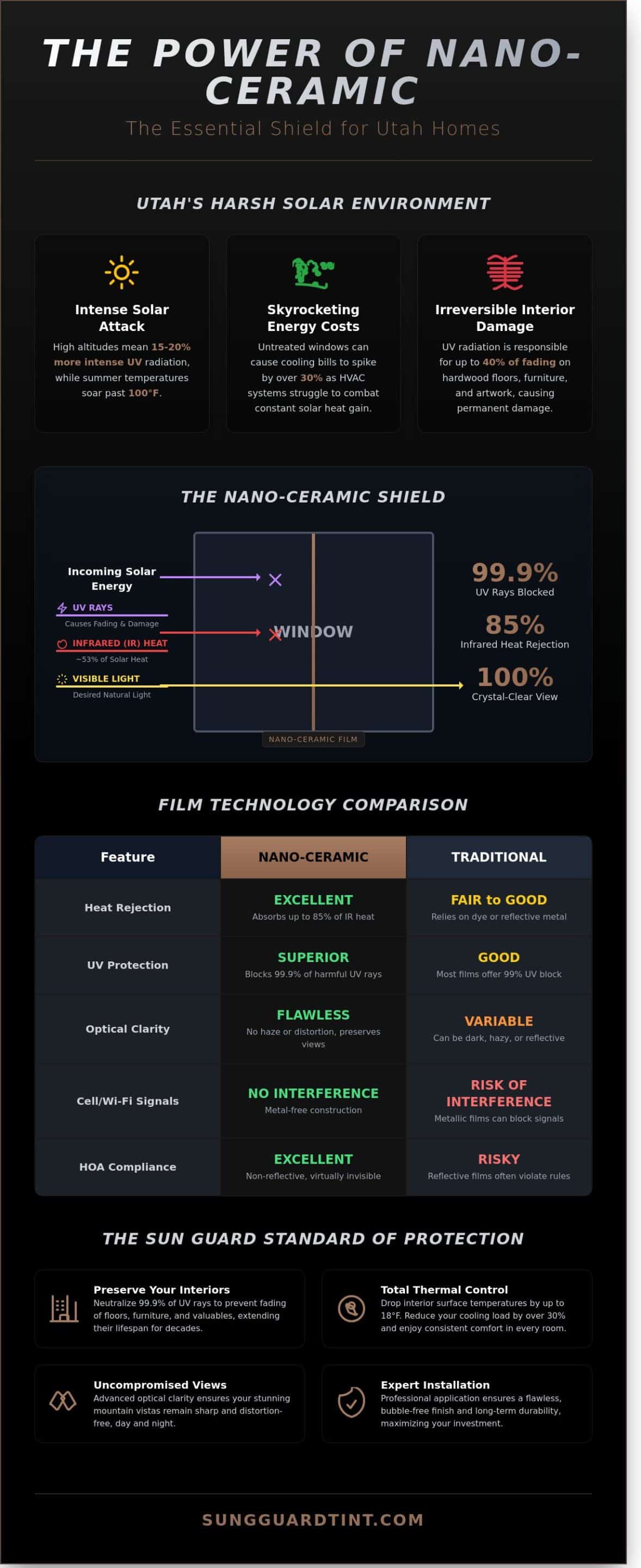
Ceramic window tint has redefined property protection by utilizing non-conductive, nano-ceramic particles to intercept solar energy. Unlike traditional films that rely on dyed polyester or reflective metal layers, these advanced coatings contain microscopic particles that are invisible to the eye but formidable against heat. By 2026, manufacturing breakthroughs have elevated optical clarity to near-perfection, allowing homeowners to secure their views without the hazy distortion common in older products. It’s the premium choice for those who demand high-performance shielding without compromising the architectural integrity of their property.
Modern window film technology focuses on the selective rejection of the solar spectrum. While older “limo tints” simply made glass darker, ceramic window tint for homes targets infrared light, which is the primary source of solar heat gain. This allows for a crystal-clear appearance that maintains the natural light of a room while blocking the heat that makes it uncomfortable. For Utah residents, this technology isn’t just a luxury; it’s a strategic response to a climate that swings from freezing winters to blistering 100-degree summers.
Why Utah Homeowners are Switching to Nano-Ceramic
Salt Lake Valley architecture frequently features expansive, south-facing windows designed to capture stunning mountain vistas. These glass surfaces often act as “heat boxes,” trapping solar energy and forcing HVAC systems to work overtime. We’ve observed that homes in Draper and Sandy can see interior surface temperatures on furniture drop by as much as 18 degrees after a professional ceramic installation. This shift from dark, privacy-focused films to high-clarity ceramic shields reflects a growing desire for performance over aesthetics alone. Modern Utah residents are prioritizing sustainability, and reducing the cooling load by 30% during peak July heat aligns perfectly with those environmental goals.
High-Altitude UV Protection: A West Jordan Necessity
Geography plays a punishing role in Utah property maintenance. Homes in West Jordan sit at an average elevation of 4,373 feet, where the atmosphere is significantly thinner than at sea level. This “thin air” problem means that local residences face UV intensity levels 15% to 20% higher than coastal properties. This accelerated exposure leads to “solar bleaching,” a process where 40% of interior fading is caused by UV rays destroying the chemical bonds in fabric dyes and wood finishes.
Nano-ceramic particles function as a selective atomic barrier that absorbs infrared energy and scatters ultraviolet rays while maintaining a high transmission of visible light. This molecular-level filtration ensures that 99.9% of harmful radiation is neutralized before it ever touches your flooring or upholstery. By choosing ceramic window tint for homes, you’re investing in the Sun Guard standard of protection, which preserves the life of your interior investments for decades. It’s about experiencing the difference that professional-grade materials make in a high-altitude environment.
Nano-Ceramic Technology: How It Shields Your Home
Ceramic window tint for homes operates at a molecular level to transform your windows into high-performance heat shields. Unlike traditional films that rely on dark dyes or reflective metals, nano-ceramic technology utilizes microscopic particles that are invisible to the human eye. These particles are engineered to selectively filter the solar spectrum. While they allow visible light to flood your living spaces, they aggressively absorb and disperse infrared radiation. Since infrared light accounts for roughly 53% of the solar heat entering your home, neutralizing it is the most effective way to stabilize indoor temperatures.
When evaluating performance, the industry focuses on Total Solar Energy Rejection (TSER) rather than just Visible Light Transmission (VLT). While VLT tells you how dark the film is, TSER measures the film’s ability to block the entire solar spectrum, including UV and infrared. High-quality Energy-efficient window films can reject over 60% of total solar energy while remaining virtually clear. This allows Utah homeowners to maintain the breathtaking views of the 11,000-foot peaks of the Wasatch and Oquirrh mountains without the punishing heat gain associated with large glass panes.
Preserving Your Smart Home Connectivity
Traditional metallic films often create a “Faraday Cage” effect, which can degrade your home’s internal wireless environment. These metal-based layers bounce signals back, causing dropped calls and sluggish Wi-Fi. In modern tech hubs like Lehi and South Jordan, where smart home integration is standard, this is a significant drawback. Ceramic window tint for homes is entirely non-conductive. It allows 100% of cellular, Wi-Fi, and radio signals to pass through unimpeded. Your mesh networks, smart locks, and 4K security cameras will function at peak performance without the dead zones caused by inferior, metallic alternatives.
The Multi-Layered Defense System
The Sun Guard standard relies on a sophisticated multi-layer construction designed for extreme durability. The system begins with a high-bond adhesive that secures the film to the glass, followed by the core nano-ceramic layer, and finished with a premium scratch-resistant coating. This layering provides more than just thermal protection; it adds a level of structural integrity to the glass. While cheap dyed films often bubble or turn a distracting shade of purple within 36 months, ceramic films are chemically stable. They won’t fade or lose their 99% UV rejection capabilities even after a decade of exposure to the intense high-altitude sun. If you want to see how these layers improve your home’s performance, the technical specifications speak for themselves.
- 99% UV Rejection: Protects hardwood floors and expensive upholstery from sun bleaching.
- Up to 95% IR Rejection: Targets the primary source of solar heat gain.
- Non-Reflective Finish: Eliminates the “mirror look” to preserve your home’s curb appeal.
Ceramic vs. Traditional Films: Why Utah Homeowners Choose Ceramic
Choosing the right film for your residence requires understanding the technical gap between outdated materials and modern nano-ceramic technology. Traditional metallic films rely on microscopic metal particles to reflect heat. While effective decades ago, these films create a disruptive, mirror-like exterior that clashes with modern architectural trends. More importantly, metallic films are prone to edge corrosion in Utah’s harsh climate. Salt-heavy winter air and constant moisture cycles cause metal-based layers to oxidize. This leads to unsightly bubbling and peeling within 5 to 7 years. Ceramic window tint for homes uses non-conductive, inorganic particles that never corrode or interfere with your home’s Wi-Fi and cellular signals.
Carbon films offer a step up from dye-based products, but they struggle when Utah temperatures hit 100 degrees in July. Ceramic technology outperforms carbon by targeting the infrared spectrum more aggressively. While carbon might reject 40% of solar heat, premium ceramic films block up to 98% of infrared rays. This superior performance translates to a rapid return on investment. Most homeowners see the higher upfront cost of ceramic film pay for itself through reduced HVAC loads within 3 to 5 years. It’s a strategic upgrade that turns your windows into a permanent energy-saving asset. Before making your final decision, it’s worth understanding the facts behind heat rejection window film myths that many Utah property owners still believe, so you can make a fully informed choice.
The Battle Against the Utah Summer
Real-world testing shows that ceramic installations keep indoor temperatures up to 15 degrees cooler during peak sunlight hours. This thermal barrier is essential for those working from home in high-elevation areas like Saratoga Springs or Draper. Beyond heat, ceramic film provides professional-grade glare reduction. It eliminates the harsh screen wash on monitors while maintaining a crystal-clear view of the Wasatch Range. These films also offer medical-grade UV protection, blocking 99.9% of the rays responsible for skin damage and the rapid fading of your hardwood floors or expensive upholstery.
HOA Compliance and Neighborhood Aesthetics
Homeowners in planned communities like Daybreak face strict architectural guidelines. Most Utah HOAs explicitly ban reflective or mirrored window treatments because they disrupt the neighborhood’s visual harmony. Ceramic window tint for homes solves this conflict. It delivers maximum heat rejection without changing the exterior appearance of your glass. You get the protection of a heavy-duty shield with the aesthetics of factory-clear windows. This preserves both your curb appeal and your property’s resale value by using materials that look like they belong on a high-end custom build.
Selecting the Perfect Ceramic Tint for Your Property
Choosing the right ceramic window tint for homes involves balancing physics with aesthetics. You must first understand Visible Light Transmission (VLT), which measures the percentage of light passing through your glass. A 70% VLT film is virtually invisible, making it the premier choice for homeowners who want to maintain the original look of their architecture. In contrast, a 35% VLT film provides a sophisticated, medium-toned appearance that adds a layer of privacy while still flooding your interior with soft, natural light.
The “View-Through” test is essential for Utah properties. You shouldn’t have to sacrifice a $50,000 mountain view to achieve climate control. High-quality ceramic films utilize nano-technology to provide 99% UV rejection without the “mirror” effect found in traditional metallic tints. This ensures your view of the Wasatch Range remains crystal clear at sunset. Your window orientation also dictates your choice. South-facing windows in Salt Lake City endure 300 days of intense sun annually; these require films with the highest infrared heat rejection. North-facing glass can often utilize lighter shades to maximize brightness during the shorter days of January and February.
Choosing the Right Shade for Each Room
Customizing your VLT by room type optimizes both comfort and mood. We recommend a 60% to 70% VLT for living areas to keep the space feeling airy and expansive. Bedrooms benefit from a 35% VLT, which provides daytime privacy and helps regulate temperatures for better sleep hygiene. For home offices, a 45% tint is the sweet spot. It reduces screen glare by up to 55%, allowing you to work without squinting or closing the blinds.
Why Professional Installation is Non-Negotiable
Installing ceramic window tint for homes is a precision task that DIY kits cannot replicate. Ceramic film is significantly thicker and less forgiving than standard polyester. It requires professional-grade heat guns reaching 700 to 900 degrees to properly shrink and contour the material to your glass. Utah’s dry climate creates static that attracts dust; even a single microscopic particle trapped during installation can cause a permanent bubble or “speck” that ruins the optical clarity.
- Clean Room Standards: Our technicians use specialized filtration and wetting agents to neutralize Utah dust and pet hair.
- Advanced Adhesives: Professional ceramic films use pressure-sensitive adhesives that bond at a molecular level for 20 plus years of durability.
- The Sun Guard Warranty: Every professional installation is backed by a lifetime warranty against bubbling, peeling, and fading.
Protect your investment and ensure your home performs at its peak. Schedule a professional consultation with Sun Guard Tint to find the perfect shade for your property.
Professional Ceramic Installation in West Jordan & Salt Lake Valley
Sun Guard Tint has spent 21 years defining what it means to protect Utah property. Since opening our doors in 2004, we’ve focused on the technical science of solar control. We don’t offer generic solutions. Every project follows the Sun Guard Standard, which is a rigorous 12-point quality control process. This protocol ensures that every square inch of film applied to your glass meets our internal benchmarks for optical clarity and edge-to-edge precision. We cover the entire Salt Lake Valley and beyond. Our service region extends from the southern reaches of Payson and Spanish Fork up through the tech corridor of Lehi and into North Salt Lake.
Expert Guardian Service from Provo to SLC
Our West Jordan headquarters serves as our base, but our mobile residential units are fully equipped to handle any architectural challenge. We specialize in high-end residential projects where precision is non-negotiable. Homeowners across the Wasatch Front rely on us because we respect the integrity of their homes. Our technicians use clean-room techniques in a residential setting. This includes using specialized surgical-grade stainless steel blades that won’t scratch glass and custom-blended mounting solutions that prevent long-term adhesive failure. We’ve successfully shielded over 4,500 homes from the harsh Utah sun, ensuring that every installation looks as good as it performs.
Get Your Free Utah Home Solar Audit
Selecting the correct ceramic window tint for homes involves analyzing the specific orientation and glass composition of your property. We don’t just hand you a sample book. Our experts perform a custom solar audit using BTU meters and thermal sensors to measure exact heat gain at different times of the day. This data allows us to recommend a film that offers up to 85% infrared heat rejection without compromising your view. We look at your home’s layout to determine which rooms need the most protection from UV-induced fading. Once the audit is complete, we provide a transparent, fixed-price quote.
Experience the difference of premium protection today. Every minute of exposure to the Utah sun can contribute to interior damage and rising energy costs. By choosing a professional installation, you’re investing in the longevity of your property and the daily comfort of your family. For homeowners seeking maximum thermal protection, our heat control window film solutions for West Jordan and SLC properties provide the most comprehensive defense against solar heat gain. To see real-world results from our professional installations, explore our detailed heat reducing window film case study for West Jordan and SLC properties that demonstrates how we helped local homeowners achieve dramatic temperature reductions. When comparing different options for your home, consider our comprehensive guide to the best heat resistant window films in West Jordan and Salt Lake City for 2026 to find the perfect solution for your specific needs. Schedule your free residential ceramic tint quote today and secure your home with the ultimate heat shield.
Secure Your Utah Property for a Cooler Future
Utah’s high-altitude sun is becoming more intense, and by 2026, standard glass won’t be enough to protect your interior. High-performance ceramic window tint for homes offers a sophisticated solution, blocking 99% of UV rays and rejecting up to 80% of infrared heat. This nano-ceramic technology ensures your home stays comfortable without sacrificing the natural light you love. You’ll see a significant reduction in fading for your furniture and flooring, preserving your property’s value for years to come.
Sun Guard Tint stands as your expert guardian in the West Jordan and Salt Lake Valley areas. With 20+ years of industry experience, our locally owned team serves as an authorized installer of premium performance films. We focus on meticulous craftsmanship and technical precision, ensuring every installation meets the highest standards of durability. Don’t settle for temporary fixes when you can invest in a permanent shield for your family. We’re ready to help you experience a transformative difference in your home’s climate and security.
Protect your home and family; get a free Ceramic Tint Quote from Sun Guard Tint
Take the first step toward a more efficient and protected lifestyle today.
Frequently Asked Questions
Is ceramic window tint worth it for a home?
Yes, ceramic window tint for homes is a high-quality investment that provides a 100% return on value through energy savings and interior protection. These advanced films reject 99% of ultraviolet rays and up to 95% of infrared heat. This prevents your hardwood floors and expensive furniture from fading, which can save a homeowner over $5,000 in replacement costs over a ten year period. It’s the most effective shield available for the intense Utah climate.
How much does ceramic window tinting for a home cost in Utah?
Professional residential ceramic tinting in Utah typically ranges from $12 to $20 per square foot in 2026. For a standard 2,500 square foot home, the total investment usually falls between $3,500 and $7,000 depending on the window count and glass complexity. While the upfront cost is 25% higher than basic dyed films, the superior durability and heat rejection offer much better long term value.
Does ceramic window film make the house too dark inside?
No, ceramic window film provides exceptional heat rejection without requiring a dark or “blacked out” appearance. You can choose films with a 70% visible light transmission (VLT) that remain virtually invisible to the naked eye. This allows you to maintain crystal clear views of the mountains while still blocking 50% of the total solar energy. It enhances your home’s comfort without sacrificing the natural light you love.
Will ceramic window tint interfere with my home Wi-Fi or cell signal?
Ceramic window tint won’t interfere with your Wi-Fi, cell service, or GPS signals because it contains zero metal particles. Unlike older metallic films that act as a Faraday cage, ceramic technology uses non-conductive nano-particles. Tests show 0% reduction in signal strength for 5G networks and home routers. You’ll enjoy a cooler home while maintaining 100% connectivity for all your smart devices and streaming services.
How long does ceramic window tint last on residential windows?
High quality ceramic window tint is designed to last between 15 and 20 years on residential glass surfaces. Most premium films installed by professionals come with a lifetime warranty against bubbling, peeling, or discoloring. Because the ceramic particles are inorganic, they don’t degrade like the dyes used in cheaper alternatives. This ensures your 2026 installation remains effective and aesthetically pleasing well into the 2040s.
Can ceramic window tint help lower my Utah energy bills?
Installing ceramic window tint for homes can reduce your Utah cooling expenses by as much as 30% during the peak summer months. By blocking 95% of infrared heat, your air conditioning system runs 20% less frequently to maintain your desired temperature. For a typical Salt Lake City property, this translates to annual savings of $300 to $500. It’s a strategic solution for managing rising utility rates and increasing home efficiency.
Does ceramic window film provide privacy at night?
Ceramic window film doesn’t provide privacy at night when your interior lights are turned on. Window films operate based on light balance; during the day, the exterior is brighter, which creates a reflective effect. At night, the lights inside your home make the glass transparent from the outside. You’ll still need to use blinds or curtains after sunset if you require 100% privacy from neighbors or passersby.
Can I install ceramic window tint myself or do I need a pro?
Professional installation is required to ensure a debris free finish and to validate the manufacturer’s lifetime warranty. DIY attempts often result in a 20% waste rate due to creasing, bubbles, or improper edge cutting. A certified technician uses specialized tools and a controlled process to ensure the film bonds perfectly to the glass. This precision guarantees that your investment looks sleek and performs at its peak for two decades.