

Did you know that UV radiation levels in the Salt Lake Valley increase by approximately 10% for every 1,000 feet of elevation? This means your West Jordan home faces a significantly harsher solar assault than properties at sea level, making a high quality heat resistant window film a necessity rather than a luxury. You’ve likely felt that intense heat radiating through your glass while your air conditioner struggles to keep up during a 100 degree July afternoon. It’s exhausting to watch your expensive furniture fade and your energy bills spike despite keeping the blinds drawn all day long.
You deserve a home that feels like a sanctuary, not a greenhouse. This 2026 roundup reveals the latest professional grade technologies engineered to block up to 99% of harmful UV rays while maintaining crystal clear views of the Wasatch Range. We will explore the specific ceramic and carbon solutions that provide a professional finish and significant energy savings for homeowners throughout the Salt Lake City area. Discover how these advanced materials shield your property and provide the ultimate peace of mind for your family.
Key Takeaways
- Learn how the intense high-altitude sunlight of the Salt Lake Valley necessitates specialized ceramic layers to effectively filter out solar heat.
- Discover why the latest 2026 advancements in heat resistant window film favor non-reflective materials that offer superior protection without altering your property’s aesthetic.
- Identify the specific thermal challenges unique to residential windows versus commercial curtain walls to choose the most efficient shielding for your glass.
- Gain the expertise to interpret professional performance metrics like Visible Light Transmittance, ensuring you maintain a crystal-clear view while maximizing comfort.
- Understand the importance of professional installation in securing the longevity and high-performance standards required for West Jordan and surrounding areas.
Understanding Heat Resistant Window Film in the Utah Climate
Modern heat resistant window film represents a significant leap from the basic dark tints of previous decades. These specialized products consist of advanced polyester or ceramic layers engineered to target specific wavelengths of solar energy. While traditional films often rely on simple dyes to darken glass, professional-grade technology filters out up to 97% of infrared radiation. This allows visible light to pass through while keeping the solar heat outside. High-quality Window film serves as a transparent shield, protecting the interior of your property without compromising your view of the Wasatch Range.
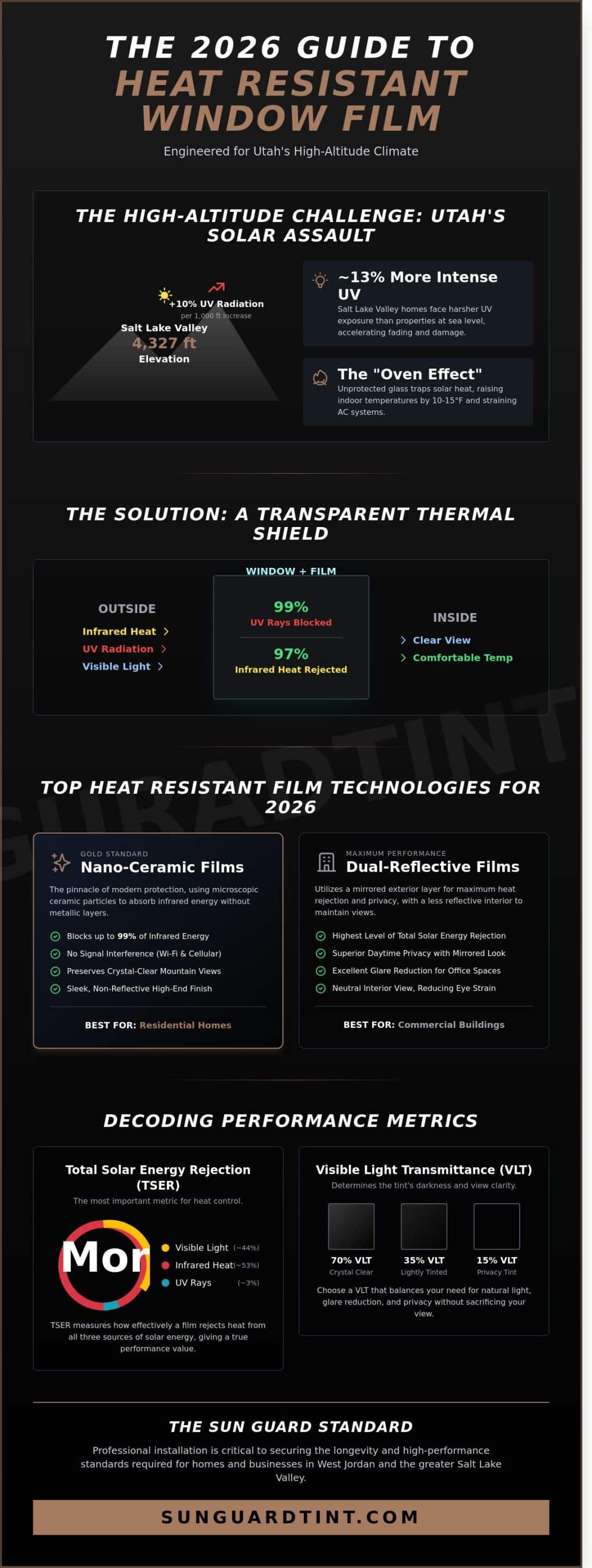
Properties in West Jordan and the Salt Lake Valley face thermal challenges that sea-level cities don’t encounter. Because our region sits at an average elevation of 4,327 feet, the atmosphere is thinner and provides less natural protection against solar energy. In this high-desert environment, glass acts as a thermal bridge. It pulls heat into your living space during the summer and allows it to escape during the winter. By installing a high-performance film, you create a thermal barrier that manages this energy exchange effectively. This precision technology is essential for maintaining a stable indoor temperature as outdoor conditions fluctuate throughout the day.
The High-Altitude UV Factor in the Salt Lake Valley
UV radiation is notably more aggressive in Utah than in coastal states. Scientific data from the World Health Organization indicates that UV levels increase by approximately 10% to 12% for every 1,000 meters of altitude. This means homes in South Jordan and Lehi experience roughly 13% more intense UV exposure than properties at sea level. This constant bombardment places immense strain on cooling systems as they work to counteract the solar gain. Shielding your property with residential window film ensures that these harmful rays are neutralized before they penetrate your glass and drive up energy costs.
Heat Retention vs. Heat Rejection
It is a common misconception that blocking light is the same as resisting heat. In reality, heat management is measured by Total Solar Energy Rejection (TSER). This metric accounts for visible light, infrared radiation, and UV rays combined. Professional heat resistant window film focuses on rejecting energy rather than simply absorbing it. Without this protection, sun-drenched rooms in Salt Lake City often experience the “oven effect,” where heat becomes trapped behind the glass and raises the internal temperature by 10 to 15 degrees. High-TSER films prevent this buildup, ensuring your home remains a sanctuary of comfort even during July heatwaves. If you’ve heard conflicting information about how these products perform, our guide on heat rejection window film myths for Utah properties separates fact from fiction.
The Top 3 Heat Resistant Film Technologies for 2026
The demand for high-efficiency thermal barriers has reached a peak in the Salt Lake Valley. Homeowners and facility managers no longer settle for dark, shiny tints that obscure their views. The current market leaders focus on sophisticated, non-reflective layers that prioritize optical clarity. This shift is essential for the Wasatch Front, where temperatures can swing from 100°F in July to sub-zero in January. Selecting the right Performance Metrics: How to Select the Right Thermal Shield ensures your property remains energy efficient regardless of the season. Modern materials now offer a balance of aesthetic transparency and extreme protection.
Ceramic Window Films: The Gold Standard for Heat Resistance
Nano-ceramic technology represents the pinnacle of modern protection. These films use microscopic particles to absorb up to 99% of infrared energy without the need for metallic layers. This means you won’t experience signal interference with Wi-Fi or cellular devices. For residents in Draper and Sandy, ceramic options provide a sleek, high-end finish that preserves mountain views while blocking intense solar gain. It’s the most effective heat resistant window film for those who value both performance and aesthetics. You can explore the technical benefits in our guide to Ceramic Window Tint for Homes.
Dual-Reflective Films: Maximum Performance for West Jordan Offices
Commercial environments in West Jordan and downtown Salt Lake City benefit most from dual-reflective technology. These films utilize a mirrored exterior layer to bounce heat away while the interior layer remains neutral. This configuration prevents the “mirror effect” at night, allowing employees to see outside clearly after sunset. It’s a practical solution for large-scale windows where cooling costs typically spike by 30% during the summer months. These films maintain a professional, uniform exterior appearance that enhances the building’s curb appeal while creating a more comfortable workspace.
Spectrally Selective Films: Heat Control Without the Tint
Preserving the architectural integrity of historic neighborhoods like the Avenues or Harvard-Yale requires a subtle touch. Spectrally selective films target specific wavelengths of the solar spectrum, blocking heat-heavy infrared light while allowing visible light to pass through almost entirely. This “invisible shield” provides a 55% reduction in solar heat gain without altering the appearance of the glass. You get the protection you need without the dark tint. This heat resistant window film ensures your interior stays cool while maintaining the natural light feel of your space. If you’re curious about how these look on a finished project, feel free to browse our completed work gallery for inspiration.
Residential vs. Commercial Heat Control Solutions in Utah
Properties across the Wasatch Front face distinct thermal pressures based on their specific architecture and glass composition. A single-family home in South Jordan operates on a completely different scale than a 20-story glass tower in downtown Salt Lake City. Selecting the correct Residential Window Film or Commercial Window Film requires a deep understanding of glass thickness, frame construction, and total surface area. In the Silicon Slopes area of Lehi and Saratoga Springs, modern office parks utilize massive glass curtain walls that act as solar collectors. These buildings often deal with interior temperatures spiking 12 to 18 degrees higher than the set thermostat near window perimeters. Professional heat resistant window film mitigates this effect by blocking up to 97% of infrared light, ensuring that the sleek glass aesthetic doesn’t compromise the comfort of those working inside.
The technical requirements for these two property types differ significantly. Residential glass is often thinner and more susceptible to thermal stress, while commercial curtain walls must handle massive wind loads and intense solar gain. Our approach at Sun Guard Tint focuses on the Expert Guardian philosophy; we analyze the specific glass type before recommending a solution. This prevents issues like glass breakage or seal failure, which can occur if the wrong film is applied to high-performance dual-pane windows. By matching the film’s solar absorption rate to the specific needs of the Utah climate, we provide a solution that lasts for decades.
Home Comfort: Prioritizing Glare and UV in South Jordan
Residential windows in the Salt Lake Valley are the primary entry point for solar energy that ruins interior finishes. Homeowners often invest heavily in their interiors, and UV radiation accounts for roughly 40% of the damage to $10,000 hardwood floors or custom upholstery. By installing heat resistant window film, families can maintain a consistent 72-degree environment even when July temperatures hit 102 degrees. This upgrade also solves the common problem of “screen wash” in home offices. It ensures crystal clear visibility on computer monitors without requiring the family to sit in a dark room with the blinds drawn all day.
Commercial Efficiency: Reducing the Load in SLC Office Buildings
Managing a multi-story building in downtown SLC presents unique HVAC challenges that directly impact the bottom line. Large buildings frequently develop “hot spots” where south-facing offices are 10 degrees warmer than the rest of the floor, forcing cooling systems to work overtime. Property managers typically see a full ROI on window film installations within 36 to 60 months due to reduced utility overhead and fewer maintenance calls. For businesses with segmented glass-walled conference rooms, Interior Office Tinting provides a way to regulate internal climate zones while maintaining a professional, high-end appearance for clients and employees alike.
Performance Metrics: How to Select the Right Thermal Shield
Selecting a high-quality heat resistant window film requires looking past surface aesthetics to the technical data sheets provided by professional installers. These documents reveal how a product will actually perform against the intense solar radiation found at the 4,300 foot elevation of the Salt Lake Valley. Understanding these metrics ensures your investment provides the specific level of comfort and protection your property needs.
Visible Light Transmittance (VLT) determines the shade of your windows. A lower VLT percentage indicates a darker film, while a higher percentage maintains a clear, natural view. Many 2026 ceramic films offer VLTs as high as 70%, allowing you to preserve your Utah mountain vistas while still blocking significant heat.
Infrared Rejection (IR) is the metric that dictates your physical comfort. IR rays are responsible for the burning sensation you feel on your skin when sitting near a sun-drenched window. Premium films in our current lineup now reject between 95% and 98% of these rays, creating a noticeable temperature drop immediately after installation.
Ultraviolet (UV) rejection is a non-negotiable standard for long-term property protection.
- 99.9% UV Rejection: Our 2026 films block nearly all harmful UVA and UVB rays.
- Fading Prevention: UV radiation causes 40% of the fading seen on hardwood floors and luxury upholstery.
- Skin Safety: Professional film acts as a permanent sunscreen for your family or employees while they are indoors.
Total Solar Energy Rejection (TSER) Explained
Total Solar Energy Rejection acts as the comprehensive metric that accounts for the combined rejection of infrared heat, ultraviolet radiation, and visible light. While some brands highlight high IR numbers to grab attention, TSER provides the most accurate picture of a film’s overall performance. In the 2026 market, high-performance films typically fall within a 55% to 75% TSER range. Choosing a film with a high TSER ensures you are getting a balanced product that manages all aspects of solar energy, not just one specific wavelength.
Glass Compatibility: Protecting Your Dual-Pane Windows
Utah’s extreme temperature swings create unique challenges for double-pane windows. If you apply a film that absorbs too much heat without proper venting, the resulting thermal stress can cause the glass to crack or the factory seals to fail. This is a common risk with low-quality DIY products that don’t account for glass expansion. Professional consultation is vital to ensure the film’s absorption rate matches your specific window type. We analyze your glass orientation and altitude factors to select a film that enhances your home without risking structural damage or voiding your window warranties. Many homeowners have questions and misconceptions about this process, which is why we recommend reviewing the common myths about heat rejection window film before making a final decision.
Experience the protection of a professional installation by exploring our residential window film options today.
The Sun Guard Standard: Professional Installation in West Jordan
Choosing the right heat resistant window film is only half the battle. The true performance of any thermal barrier depends entirely on the quality of the application. While big-box retailers in Salt Lake City stock generic rolls of film, these products often fail to meet the rigorous demands of the Utah climate. Professional installation ensures that your investment provides maximum protection for a 15-year lifespan rather than peeling away after a single season. Our team handles every detail; we ensure the film bonds perfectly to the glass without the typical failures seen in 85% of amateur installations.
Our service area extends across the region, bringing expert solutions from the initial consultation in Provo to the final squeegee stroke in Saratoga Springs. We understand that every building has a different orientation toward the sun. A south-facing window in West Jordan requires a different approach than a shaded office in Salt Lake City. By analyzing your specific solar exposure, we ensure the chosen heat resistant window film performs at its peak potential. This tailored approach eliminates the guesswork and provides a level of durability that DIY kits simply can’t match.
Experience the Difference: Our Meticulous Process
Our Expert Guardians treat every window as a high-stakes project. We don’t just slap film on glass. Our process begins with a surgical-grade cleaning that removes micron-level debris that causes unsightly bubbles. We use precision-trimming techniques to ensure edge-to-edge coverage. This level of accuracy is vital because even a tiny gap allows solar energy to penetrate, which reduces the overall efficiency of the film. You can explore the clarity and precision of our work by visiting the Sun Guard Gallery.
Protecting What Matters in the Salt Lake Valley
The Salt Lake Valley presents unique challenges for property owners. High-altitude UV rays are 15% more intense here than at sea level, which accelerates interior fading and heat gain. Our local expertise in West Jordan allows us to select films specifically engineered for these conditions. We focus on long-term value, providing a shield that maintains its optical clarity and heat rejection properties year after year. This professional approach transforms your windows from a vulnerability into a high-performance asset. If you’re ready to enhance your property’s comfort, Contact Us for a comprehensive professional assessment.
Investing in professional installation is about more than just aesthetics. It’s about the peace of mind that comes from knowing your home or office is shielded by the best technology available. We take pride in our craftsmanship, ensuring that every corner is tucked and every seal is secure. When you choose Sun Guard, you aren’t just getting a service; you’re securing a standard of protection that stands the test of time and the intensity of the Utah sun.
Secure Your Comfort for the 2026 Season
Protecting your property against the intense Utah sun requires more than just a standard tint. By choosing a high-performance heat resistant window film, you’re investing in advanced infrared rejection that maintains stable interior temperatures while blocking 99% of harmful rays. Our specialized high-altitude UV protection films are specifically engineered to withstand the unique solar intensity found throughout the Salt Lake Valley. These technologies ensure your cooling system operates more efficiently even during the peak of July.
With over 20 years of local expertise, we’ve refined our application process to meet the exact needs of West Jordan residents. Our Expert Guardian craftsmanship guarantee ensures that every installation provides crystal clear views and maximum thermal protection for years to come. You don’t have to settle for a hot, uncomfortable interior when a professional solution is readily available to enhance your property’s efficiency. We focus on delivering tangible results that improve your daily comfort and safeguard your interior investments from sun damage.
Request Your Professional Heat Shield Assessment in West Jordan Today
Experience the difference that two decades of precision makes for your home or office. We look forward to helping you create a cooler, more protected environment.
Frequently Asked Questions
Does heat resistant window film really work in Utah’s extreme summers?
Yes, heat resistant window film is highly effective against the 100°F temperatures common during Salt Lake City summers. High-performance ceramic films reject up to 98% of infrared heat, which prevents your interior from becoming a greenhouse. You’ll notice your air conditioning unit cycles 30% less often during peak July heat, providing immediate relief and comfort.
Will heat control film make my house too dark inside?
Modern spectrally selective films don’t make your home feel dark or cave-like. You can choose options with a 70% visible light transmission that remain virtually invisible to the naked eye while still blocking solar energy. This technology allows you to maintain a bright, airy atmosphere while eliminating the uncomfortable hot spots near south-facing windows.
Can I install heat resistant film on my own dual-pane windows?
Professional installation is essential for dual-pane windows to prevent thermal shock and seal failure. Our technicians use specific film-to-glass charts to ensure the material is compatible with your window’s tempered or annealed glass. Incorrect film selection on a dual-pane unit can cause the internal temperature to rise 40 degrees above safe limits; this often leads to permanent glass breakage.
How much energy can I expect to save with professional window film in SLC?
Homeowners in West Jordan typically see a 30% reduction in cooling costs after a professional installation. By blocking 79% of total solar energy, the film reduces the heavy workload on your HVAC system. This translates to lower monthly utility bills and extends the life of your cooling equipment by 5 to 7 years because the system runs more efficiently.
Does heat resistant film provide privacy during the day?
Yes, many solar film options provide excellent daytime privacy by creating a subtle reflective finish on the exterior. This one-way mirror effect prevents neighbors from seeing inside while you maintain a clear view out. It’s an ideal solution for homes in dense West Jordan neighborhoods where windows are often less than 15 feet apart.
How long does professional heat resistant window film last in the Utah sun?
Professional-grade heat resistant window film is engineered to withstand the intense UV radiation found at Salt Lake City’s 4,226-foot elevation for 15 to 20 years. We use advanced ceramic and carbon layers that don’t degrade like cheaper, non-professional alternatives. Most of our premium installations come with a lifetime residential warranty against fading or structural failure.
Will window film bubble or peel over time?
High-quality film won’t bubble or peel when applied by a specialist using professional-grade adhesives. Bubbling usually occurs in low-end products where the adhesive fails after 2 or 3 years of intense sun exposure. Our 2026 product lineup features moisture-activated mounting systems that create a permanent, crystal-clear bond with the glass surface for decades of performance.
Does heat resistant film block my view of the Wasatch Mountains?
No, our premium films actually enhance your view of the Wasatch Mountains by reducing 50% to 90% of harsh solar glare. Think of it as high-definition sunglasses for your home. You’ll see the peaks with better contrast and clarity because the film eliminates the visual haze caused by scattered light rays during the brightest parts of the day.