

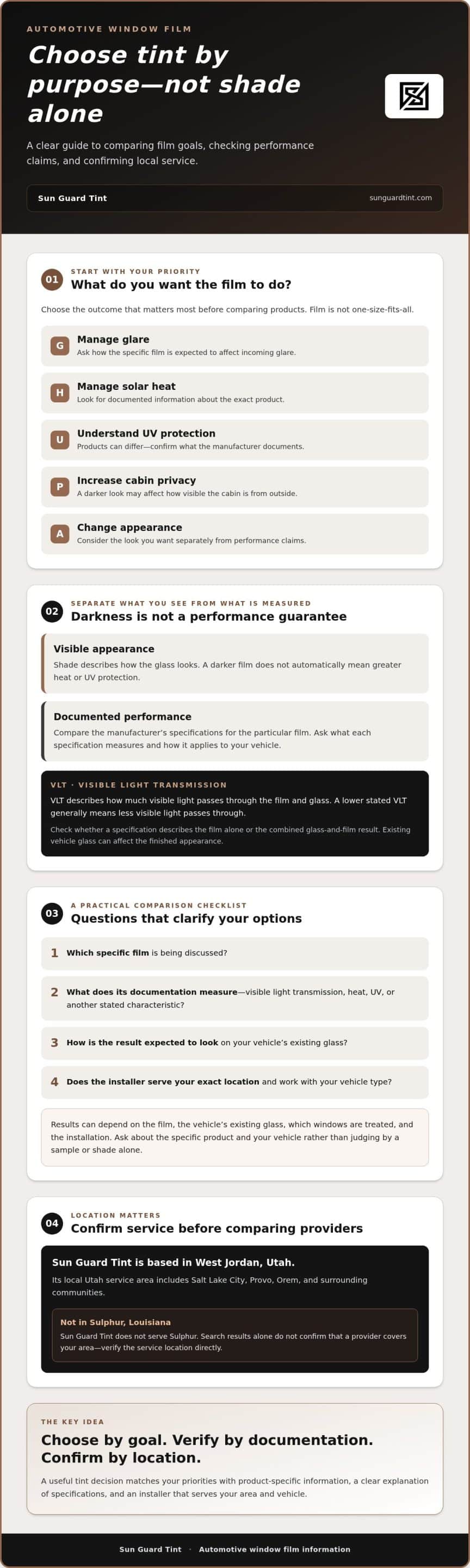
If you are searching for window film in Utah, start by identifying what you want your tint to do: manage solar heat, reduce glare, provide UV protection, add cabin privacy, or enhance your vehicle's appearance. Then, check whether a prospective installer serves your specific location and can properly work with your vehicle's glass.
Comparing film options is much easier when you separate aesthetic preferences from documented performance. Ask about specific products, what their manufacturer specifications measure, and how the film will actually look on your car. Always confirm a provider's service area directly rather than assuming out-of-state businesses serve your area just because they appear in search results.
Sun Guard Tint is based in West Jordan, Utah, and does not serve Sulphur, Louisiana. We provide professional automotive window tinting at our dedicated facility for customers throughout our local Utah service area, including Salt Lake City, Provo, Orem, and surrounding communities. This guide explains what to look for when choosing a window film provider and how local Utah readers can benefit from our expert services.
Key Takeaways
- Decide whether glare, solar heat, UV exposure, privacy, or appearance is your main priority before comparing films.
- For tint Sulphur searches, remember that a darker film does not automatically provide greater heat or UV protection.
- Ask for documentation that supports claims about the specific film, and clarify what each specification measures.
- Confirm that an installer serves your exact location and vehicle type before comparing options or booking.
- Sun Guard Tint is based in West Jordan, Utah, and serves Utah communities, not Sulphur, Louisiana.
Why Drivers in Sulphur Consider Window Tint
Automotive window tint is film professionally applied to vehicle glass to change its appearance and help manage how light and solar energy pass through. Drivers searching for tint sulphur may be looking to reduce glare, manage solar heat or UV exposure, increase cabin privacy, or give the vehicle a different look.
Film is not a one-size-fits-all solution. Results depend on the film, the vehicle’s existing glass, which windows are treated, and the installation. Ask how a particular option is expected to perform on your vehicle rather than judging it by a sample or its shade alone.
What can automotive window tint help with?
Drivers commonly explore tint to manage glare and solar heat. Depending on its documented characteristics, a film may help reduce incoming glare or solar energy. UV protection is another potential benefit, but products can differ. Ask for information about the exact film instead of assuming all tints offer the same level of protection.
Privacy and appearance are separate considerations. A darker look may affect how visible the cabin is from outside, but darkness alone does not show how well a film manages heat or UV exposure. For a general overview of what window film is made of and the kinds of film available, see Wikipedia’s introduction to the subject.
What should Sulphur drivers expect from a tint consultation?
A useful consultation should begin with your vehicle and your priorities. Explain whether glare, heat, UV exposure, privacy, or appearance matters most. The installer should discuss options for your vehicle’s glass and explain their documented characteristics, including the difference between visible darkness and performance claims.
Featured snippet: Automotive window film is a thin material professionally applied to vehicle glass to alter its appearance and help manage light and solar energy passing through.
- Ask how the film’s documented characteristics relate to your main goal.
- Request product information that supports the installer’s explanation.
- Confirm the provider serves your exact location and works with your vehicle type.
Location matters, too. Sun Guard Tint is based in West Jordan, Utah, and serves Utah communities, not Sulphur, Louisiana. Its cloaking window tint information is not evidence of local service in Sulphur. Check a provider’s service area directly before making a decision.
How Window Tint Film Works on Vehicle Glass
Window film changes how light and solar energy pass through vehicle glass. The film’s construction and materials affect its appearance and performance, so products that look similar may have different documented characteristics. The vehicle’s existing glass and the installation also influence the finished result.
For drivers researching tint sulphur, the useful distinction is between what you can see and what a film’s documentation supports. A darker appearance describes how the glass looks; it does not, by itself, establish how effectively the film manages heat or UV exposure. Ask for manufacturer documentation for the specific product and have the installer explain the claims in plain language.
Does darker tint always mean better performance?
No. Visible darkness and heat or UV performance are different measures. A dark film may fit a preferred look or privacy goal, while a lighter-looking option may have its own documented performance characteristics. Compare the evidence for the exact products you are considering, then ask an installer how they may suit your priorities and vehicle.
The right tint level also depends on the vehicle and applicable requirements. Check current legal information for your situation rather than relying on a general recommendation.
What does a film specification tell you?
Visible light transmission, often abbreviated as VLT, describes how much visible light passes through the film and glass. A lower stated VLT generally means less visible light passes through. The vehicle’s existing glass can also affect the finished appearance, so ask whether a specification describes the film alone or the combined glass-and-film result.
Request documentation for the specific film under consideration. Look for clearly explained information about visible light transmission and any stated heat or UV performance. Ask how those figures apply to your vehicle, and check technical claims against manufacturer documentation rather than assuming they apply to every film. The Skin Cancer Foundation’s information on UV window film offers additional context about film and sun protection. It is not a guarantee of a specific product’s performance.
For another example of how window film is presented, review Sun Guard Tint’s cloaking window tint information. Use product-specific documentation and a professional discussion to assess any option for your vehicle.
Comparing Window Tint Options for a Sulphur Vehicle
Compare films by what you want them to do, not by a product label or shade alone. Options and specifications vary by manufacturer and installer. Ask about the exact film and request documentation for its stated performance. Consider appearance, privacy, heat and glare goals, UV information, and the care instructions provided after installation.
Visible darkness describes appearance; documented film performance describes what the manufacturer’s evidence supports. Keep those measures separate as you compare tint options in Sulphur.
| Your priority | What to compare | What to ask |
|---|---|---|
| Appearance | How the film is expected to look on your vehicle, including the effect of its existing glass. | Can I review how this specific option may look on my vehicle? |
| Heat and glare management | The manufacturer’s documented claims for heat and glare, including the conditions those claims describe. | What evidence supports each stated performance claim? |
| UV information | Product-specific documentation about UV performance, rather than a general claim about a film category. | Can you show me the documentation for this exact film? |
| Privacy | The expected visual effect, considered separately from measured performance claims. | How may this option affect visibility into the cabin? |
| After-installation care | The care guidance the installer provides for the selected film after professional application. | What care instructions should I follow, and when? |
Which questions help compare two film options?
Ask the installer to explain the documented heat, glare, and UV information for each option. Clarify how each film may look on your vehicle’s glass, and request the care instructions before choosing. Comparing the same kinds of information for each product is more useful than relying on a sales label or a sample viewed away from your vehicle.
How should you assess claims about film performance?
For any quantified claim, request manufacturer documentation and check what glass, test conditions, or other context the figures refer to. Compare the same types of specifications across the options. A marketing term alone does not prove a particular result. The International Window Film Association offers general consumer information about window film; product-specific claims should be supported by the relevant manufacturer’s documentation.
If the documents do not answer a question, ask the installer to clarify it before deciding. A careful comparison helps you understand both the film’s appearance and the evidence behind its performance claims.
What Sulphur Drivers Should Ask a Tint Installer
A clear consultation should help you understand the film, the installation arrangement, and whether the provider serves your location. Before booking, confirm the business’s service area directly. A search result or broad service page does not necessarily confirm coverage for your address in Sulphur.
Use these questions to guide the conversation:
- Do you serve my location and vehicle type? Confirm the provider’s service area and whether your vehicle can be handled at its facility.
- Where does installation take place? Ask whether appointments are in-shop or mobile, and how the appointment process works.
- Which film options fit my priorities? Explain your goals and ask how each option may suit your vehicle’s glass.
- Can I review the film documentation? Request manufacturer information supporting any stated heat, glare, or UV performance claims.
- What care guidance should I follow? Ask the installer for recommendations for the professionally applied film.
- Are any terms or claims provided in writing? Request written details for any warranty or performance claim before relying on it.
What should you confirm before booking?
Check that the provider’s location, service area, appointment process, and installation arrangement fit your needs. Ask how the proposed film may look on your vehicle and request written documentation for important claims or terms. Get an explanation of anything unclear before booking rather than relying on an assumption.
How can you assess an installer’s information?
Look for specific explanations and supporting documents, not broad promises. If you ask about Louisiana requirements, the installer should be able to explain how it checks applicable rules. Verify legal information through current official sources yourself. A general tint recommendation is not a substitute for checking the requirements that apply to your vehicle.
Location is especially important for searches such as tint sulphur. Sun Guard Tint is based in West Jordan, Utah, serves Utah communities, and performs automotive tint installation at its facility. It does not serve Sulphur, Louisiana, or offer mobile automotive tinting. Its information may help explain what to discuss with a film installer, but it is not a local booking option.
Utah readers can contact Sun Guard Tint about its Utah service area. Sulphur drivers should first confirm that a provider serves their location.
Finding the Right Next Step for Window Tint in Sulphur
A practical approach is to decide what you want the film to address, compare options using product-specific documentation, and confirm that a provider serves your location and vehicle. Search results can help you find businesses, but they do not prove that a shop serves your part of Sulphur or handles your vehicle.
Sun Guard Tint is based in West Jordan, Utah, and serves Utah communities, not Sulphur, Louisiana. It is not a local Louisiana provider. Sulphur drivers should contact a provider in their area and verify coverage directly.
When should you contact a Sulphur-area provider?
Get in touch after confirming that the business serves your location and can accommodate your vehicle’s tinting needs. Bring focused questions about your priorities, how the film may look on your vehicle, the documentation behind its claims, and any written terms you want to review.
Ask where the work takes place, what care guidance the installer provides, and what documentation supports performance or warranty claims. Check applicable Louisiana requirements through current official sources rather than relying only on a provider’s general explanation.
What can Utah readers explore with Sun Guard Tint?
Sun Guard Tint is based in Utah, and its automotive tint installation is performed at its professional facility. The company does not provide mobile automotive tinting or serve Sulphur. Utah readers should confirm that their community is within the company’s service area before considering next steps.
The company’s contact page is an option for readers in a listed Utah community who want to ask about its window-film services. Vehicle tint and home window film are different applications, so specify which type of glass and service you are asking about.
For a tint sulphur search, first find a provider whose service area matches your location. Then discuss your priorities and review the film documentation before deciding.
Choose Window Film With Confidence
For tint Sulphur searches, begin with your priorities and compare documented film characteristics instead of judging performance by darkness alone. Confirm that the installer serves your location and vehicle, explain what you want the film to address, and review product information and written terms before deciding.
Sun Guard Tint is locally owned and operated in West Jordan, Utah, with over 20 years of industry experience. Its automotive tinting is performed at its professional facility, and mobile service is not offered. The business serves Utah communities, not Sulphur, Louisiana, so it is not a local installation option for Sulphur drivers.
Utah readers can explore Sun Guard Tint’s automotive window film information and check whether their community is within its service area. If you are in West Jordan, Salt Lake City, Provo, Orem, Lehi, Payson, Spanish Fork, South Jordan, or Saratoga Springs, contact Sun Guard Tint to ask about its Utah services and your window-film needs.
Frequently Asked Questions
What does window tint do for a car?
Automotive window tint is film professionally applied to vehicle glass. Drivers commonly consider it to manage glare, solar heat, and UV exposure, add cabin privacy, or change the vehicle’s appearance. Results depend on the film, glass, vehicle, and installation. Ask for documentation supporting performance claims, and do not assume a darker-looking film performs better. An installer can explain how a product’s documented characteristics relate to your vehicle and priorities.
Does darker car window tint block more heat?
Not necessarily. Visible darkness and documented heat-control performance are different characteristics, so appearance alone cannot show how well a film manages heat. Compare specifications for the exact options you are considering and ask what each figure measures, including whether it applies to the film alone or to the vehicle’s glass with film. Product-specific documentation is more useful than a broad claim about a tint category or shade.
Is window tint legal in Sulphur, Louisiana?
Do not assume a particular tint choice is legal without checking current requirements. Rules may depend on the vehicle’s glass and the requirements in effect where it is registered or driven. This article is not legal guidance. Before choosing a film, consult current official Louisiana sources or ask a qualified local professional to explain the applicable requirements. Confirm that the proposed option meets them before installation.
How do I choose a window tint installer in Sulphur?
First confirm that the provider serves Sulphur and handles your vehicle type. Ask which film options are available, what manufacturer documentation supports performance claims, and what written terms and care guidance the installer provides. Compare clear, specific answers rather than broad promises or appearance alone. If you are searching for tint Sulphur providers, verify the business’s location and service area directly. Sun Guard Tint is based in Utah, not Louisiana.
Can window tint reduce glare and cabin heat?
Drivers commonly consider window film to manage glare and solar heat, but results vary with the film, vehicle glass, and installation. Ask a local professional about your priorities and request specifications for the exact option under consideration. A claim about one product does not establish how every film will perform on every vehicle. Clear documentation helps you compare options with realistic expectations.
Does Sun Guard Tint install window film in Sulphur, Louisiana?
No. Sun Guard Tint is based in West Jordan, Utah, and serves listed Utah communities, not Sulphur, Louisiana. Its automotive tint work is performed at its professional facility, and it does not offer mobile automotive tinting. Its Utah coverage includes West Jordan, Salt Lake City, Provo, Orem, Lehi, Payson, Spanish Fork, South Jordan, and Saratoga Springs. Sulphur readers should verify a local provider’s service area directly.
What should I ask before getting my car windows tinted?
Ask whether the installer serves your location and vehicle type, which film options fit your priorities, and what documentation supports stated performance claims. Also ask how the film may look on your vehicle, and request written terms and care guidance. For questions about legal requirements, check current official sources or consult a qualified local professional before choosing. Specific answers make it easier to compare providers and make an informed decision.