
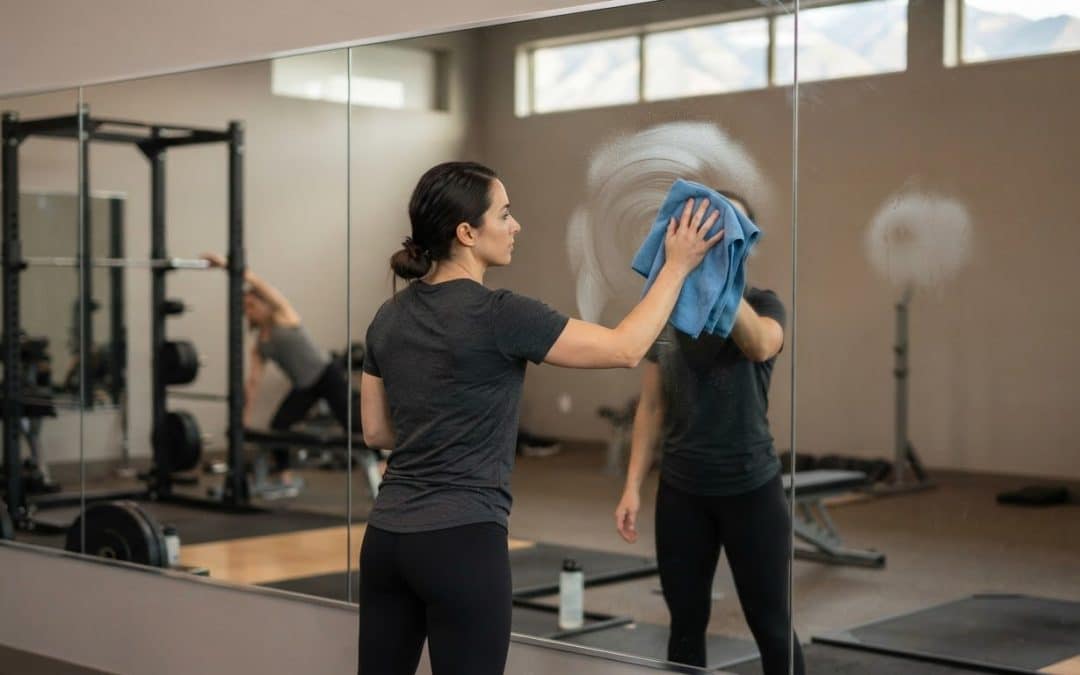
Fogged mirrors can interrupt a workout by obscuring form and making a gym feel less polished. Anti-fog for gym mirrors in Saratoga Springs requires preparing the glass and choosing a treatment suited to the mirror and its use. The right process helps keep the reflective surface clearer when warm, humid air meets cool glass.
A treatment should look even, preserve a clean finish, and come with clear care instructions. This guide explains how professionals assess and prepare gym mirrors, apply and buff anti-fog products, and compare treatment options. Glass condition, surface residue, and ongoing care all affect the process. You’ll also learn what influences performance and when reapplication may be needed, including how the mirrors are used and cleaned. Understanding these factors helps you make an informed decision about visibility and maintaining a polished training space.
Key Takeaways
- Proper mirror preparation helps create a clean surface for an even professional anti-fog application.
- Application and buffing methods affect the treatment’s finish, so the process should suit the mirror and its gym environment.
- Shaving cream, soap, and other home fixes differ from professional treatments in how they’re applied and maintained.
- Reapplication needs depend on how the mirror is used, cleaned, and exposed to moisture.
- Sprays, wipes, and coatings offer different application approaches; the best fit depends on the mirror’s needs and maintenance routine.
How professionals apply, spread, and buff anti-fog treatment on gym mirrors
Professional anti-fog for gym mirrors in Saratoga Springs starts with assessing the glass and its surroundings. The technician identifies the mirror surface, any existing coating, and visible residue. A mirror beside weights may collect fingerprints, while one near cardio equipment may develop a moisture haze. These conditions guide product selection and preparation. The goal is consistent coverage across the reflective area, not a quick application to the center.
Are anti-fog products safe for mirror coatings and gym users? Use a product only if its instructions allow application to that mirror’s surface and coating. Staff should follow label precautions and keep the area out of use during any stated application or drying period.
Before treatment, the professional reviews the product directions and the mirror’s condition. Existing coatings or earlier treatments can affect compatibility. A product suitable for plain mirror glass, for example, may not suit every treated surface. The technician follows the specified method rather than assuming sprays, wipes, and coatings share the same application requirements.
Application is planned in manageable sections. On a wide mirror wall, the technician may work panel by panel, tracking coverage and avoiding untreated gaps. Depending on the directions, the product may be applied directly or with an applicator. Careful distribution around panel seams helps create a consistent finish without excess product collecting at the edges.
The professional spreads the treatment with controlled, overlapping passes, distributing it across each section rather than concentrating it in one spot. This helps maintain an even appearance from different viewing positions. At a Saratoga Springs gym with mirrors beside several workout stations, the technician considers the finish across the full usable area.
Buffing follows the product’s stated finishing method. When the directions call for it, a clean applicator or cloth removes excess material. The technician then inspects the surface under the room’s lighting. Overhead fixtures can reveal streaks, especially near panel joins. Any visible unevenness is addressed according to the product instructions, not by adding arbitrary extra layers.
For anti-fog treatment for gym mirrors in Saratoga Springs, the final assessment covers the whole mirror, its edges, and reflections from likely user positions. The technician follows any stated handling or drying directions before the mirror returns to use. Product guidance and the mirror’s condition shape each step, helping achieve a uniform finish without assuming every surface needs the same process.
How professionals clean and prepare a gym mirror before anti-fog treatment
Preparation starts with inspecting the mirror’s surface and condition. A technician looks for fingerprints, dust, dried cleaner, and existing treatment. A mirror beside a stretching area may show handprints, while one near cardio equipment may have a fine haze. Identifying residue helps determine the cleaning approach. The technician also notes visible scratches, damaged edges, and seams between mirror panels before work begins.
Next, the technician clears the immediate work area and protects nearby equipment. This matters in gyms where benches, mats, or machines sit close to the glass. An orderly work zone helps prevent dust or cleaning residue from transferring back onto the mirror. The technician also considers the mirror’s size and panel layout. A broad, multi-panel wall needs a deliberate sequence so each section receives consistent attention.
Cleaning removes contaminants that could interfere with an even treatment. The technician uses a glass-cleaning method suited to the mirror and the anti-fog product’s instructions. Cleaner residue matters because a film left behind can affect the treated surface’s appearance. A slight streak, for example, may become obvious beneath overhead gym lighting. The professional checks the surface as cleaning progresses instead of relying on a quick glance.
Edges and joins need careful attention. Dust can gather where mirror panels meet, and fingerprints often collect near reachable corners. The technician addresses these areas without letting excess liquid run behind mirror edges or onto nearby finishes. The perimeter of a frameless mirror remains part of the inspection. With a framed mirror, the professional accounts for the frame material and its proximity to the glass.
Before treatment, the surface must meet the product’s preparation directions. The technician confirms that cleaning residue has been removed and follows any stated drying or application requirements. No single cleaner or preparation method suits every mirror, so the existing surface and product directions guide the choice. A prior coating matters because compatibility can affect the finish. The technician doesn’t assume a method used on plain glass will suit every treated surface.
A final inspection catches dust, streaks, or missed areas before anti-fog treatment begins. The technician views the mirror under the room’s lighting and across its full usable area. A smudge near a panel seam, for example, may be easy to miss when viewed straight on. This final pass creates a clean starting surface, helping the next step produce a more uniform result without masking existing marks or residue.
How professional anti-fog treatment compares with shaving cream, soap, and other home fixes
Shaving cream and soap are improvised options, while professional treatments follow product-specific application instructions. For a gym, compare surface compatibility, finish, upkeep, and the demands of shared use.
Professional Anti-Fog Treatment Versus Home Fixes
Shaving cream and soap can leave a film on mirror glass. Under overhead lighting, that film may look uneven or show streaks after wiping. In a shared gym, frequent contact and cleaning can also disturb an improvised layer. These approaches may seem convenient for a small spot, but they don’t offer the same controlled application process as a professional treatment.
A professional considers the mirror surface, existing finish, and cleaning routine before choosing a suitable product. The treatment is applied according to its instructions, then assessed for visible residue and coverage. A wall of joined mirror panels, for example, needs consistent treatment across seams and workout stations. Compare options by the finished reflection and upkeep, not just by whether the surface looks clear immediately after application.
Home remedies vary in formulation and use, so results can differ depending on the mirror and cleaning habits. Soap residue may need to be removed, while unevenly cleared shaving cream can leave visible smears. These are practical concerns in spaces where mirrors are used throughout the day. Professional application offers a more deliberate process, but the product’s directions still determine how it is used and cared for.
Choosing Sprays, Wipes, and Coatings for Gym Mirrors
Sprays, wipes, and coatings differ in format and application method. A spray is applied as a liquid; a wipe delivers product through a treated applicator; a coating is selected and used according to its specific instructions. Before choosing an approach, a professional weighs the mirror’s size, panel layout, surface condition, and expected cleaning routine.
On a broad mirror wall, consistent application across each panel matters. A wipe may provide a defined contact area, while a spray may suit a process that allows controlled distribution. Don’t assume these formats are interchangeable. The professional follows the chosen product’s directions for application and finishing rather than combining methods or adapting them without guidance.
Gym operators can compare options by considering how the mirror is used between sessions. A high-traffic studio, for example, may need a treatment compatible with its regular glass-care routine. The professional also considers existing coatings, since compatibility can affect the finish. Product instructions guide the decision, including any stated cleaning or reapplication guidance.
Home remedies and professional products aren’t equivalent simply because both aim to reduce fogging. A gym mirror’s size, lighting, and repeated cleaning make a uniform, maintainable finish especially important. Discussing these conditions with a professional helps match the application method to the mirror instead of relying on shaving cream or soap as a lasting treatment plan.

When to reapply anti-fog treatment
Reapplication timing depends on the treatment instructions, mirror use, and cleaning routine. A gym mirror used throughout the day faces different conditions from one in a lightly used studio. Rather than relying on a fixed calendar, the professional considers how the treatment performs during ordinary use. Product directions provide the starting point for maintenance and renewal.
Fogging that returns across previously treated glass can signal that an assessment is due. The technician considers where it appears and whether it follows a pattern. Haze limited to one panel, for example, may point to local residue or uneven wear. Fogging across the whole mirror calls for a broader review of the surface, room conditions, and treatment history.
Cleaning can affect how anti-fog treatment performs. Frequent wiping, strong cleaning products, or abrasive contact can disturb the treated surface. A professional reviews the gym’s glass-care routine alongside the product’s maintenance instructions. If a mirror is cleaned often between classes, that repeated contact matters more than the calendar alone. The technician can then distinguish a cleaning issue from the need to renew treatment.
Appearance matters, too. Streaks, cloudy patches, and inconsistent reflection warrant inspection before another application. These marks don’t automatically mean the treatment has worn away. Dust, cleaner residue, and fingerprints can create similar signs. A professional assesses the glass and its existing finish, then determines whether cleaning, correction, or reapplication suits the condition.
Usage patterns help guide the decision. A busy training room with repeated sessions and frequent mirror contact differs from a quiet studio used occasionally. Moisture exposure, ventilation, and mirror location also shape the conditions. The technician considers these factors alongside observed performance rather than promising a universal renewal schedule for every gym.
Before reapplying, the professional reviews the product directions and the mirror’s current condition. Existing treatment may need suitable cleaning or preparation first. Applying a fresh layer over residue can leave an uneven finish, so the technician addresses the cause of visible changes before proceeding. The selected product’s instructions guide compatibility, application, and any stated maintenance interval.
A useful maintenance record can note the treatment date, product, and cleaning practices. This information helps identify patterns when fogging returns. A change after a new cleaning routine, for instance, gives the technician a relevant detail to assess. In Saratoga Springs, gym operators can use these observations to plan maintenance around actual mirror performance, not an assumed timetable. Reapplication is most appropriate when inspection and product guidance support it.
Large-format mirrors in bathrooms, dressing areas, home gyms, studios, salons, and commercial interiors need accurate measurement, especially when they span a broad wall or have an unusual shape. Dimensions help the professional identify the glass area being assessed and keep maintenance notes tied to the right mirror. This is useful when visible changes affect one panel or an irregular section, rather than assuming every area is in the same condition.
How do professionally applied anti-fog sprays, wipes, and coatings compare for gym mirrors?
Sprays, wipes, and coatings describe different product formats, not a guaranteed performance ranking. For gym mirrors, compare how each option suits the glass, its existing finish, application area, and cleaning routine. A professional considers these factors before selecting a product and follows its directions for use.
A spray delivers treatment in liquid form. During professional application, the technician follows its instructions for placement and spreading across the glass. This format may suit a broad mirror surface when the product directions allow controlled coverage. For a wall of joined panels, the technician also accounts for seams and consistent treatment across the reflective area.
A wipe carries product on an applicator surface. Its format can help define the area being treated, such as one panel or a smaller mirror section. The professional still follows the label’s guidance for contact, coverage, and finishing. A wipe shouldn’t be assumed to need less preparation or suit every mirror just because it is compact.
A coating refers to a treatment intended to leave a layer on the glass. The term alone doesn’t establish how long it lasts, how it should be cleaned, or whether it suits a particular mirror. Those details come from the product directions. Before applying a coating, the professional considers the mirror’s condition and any existing surface treatment to avoid an incompatible finish.
In a studio with several mirror panels, consistency matters more than the package format. The technician compares how the chosen product applies across the full mirror and what its directions say about buffing or finishing. A spray, wipe, or coating shouldn’t be mixed with another product unless the instructions allow it. Each option has its own handling requirements.
Cleaning practices also influence the choice. A gym that routinely wipes mirrors between sessions has different maintenance demands from a lightly used training room. The professional considers the cleaning routine alongside product guidance, including any stated restrictions. A cleaning method that leaves residue, for example, may affect the visible finish regardless of whether the treatment began as a spray, wipe, or coating.
A useful comparison starts with the mirror, not a format label. A professional evaluates the glass, existing finish, panel layout, and expected care routine, then selects an appropriate option according to its directions. For gym operators in Saratoga Springs, this approach supports an informed choice without assuming sprays, wipes, and coatings share the same application or maintenance needs.
Sun Guard Tint
Sun Guard Tint helps property owners consider how glass solutions fit their spaces and priorities. If you’re weighing mirror treatment alongside broader glazing needs, professional guidance can clarify which concerns relate to mirrors and which may call for window-film options. Sun Guard Tint offers residential and commercial window tinting, smart window film, and graffiti protection film for suitable projects. These services address different glass needs, so they aren’t substitutes for anti-fog mirror treatment.
Share what you’re aiming to improve, such as clearer workout mirrors or added protection for other glass surfaces. Contact Sun Guard Tint to discuss your property’s glass needs.
Plan Clearer Mirrors for Your Gym
Make mirror clarity part of your facility’s ongoing care plan. Anti-fog treatment for gym mirrors in Saratoga Springs should suit the way your space operates, from busy group classes to quieter training areas. Consider how mirror visibility supports coaching, movement, and the overall feel of the room. That perspective can help you discuss an approach for your facility without treating every glass surface the same.
As you plan your next maintenance step, keep your priorities clear: a polished reflection, a suitable application, and care that fits your gym’s routine. A conversation about your mirrors can help move you from general information toward a solution suited to your space.
Contact Sun Guard Tint about gym mirrors to discuss your next step. A thoughtful plan can help your training space feel ready for every session.
Frequently Asked Questions
What anti-fog products are suitable for gym mirrors, and how can a professional help choose?
A suitable product is one whose directions permit use on the specific mirror surface and any existing finish. A professional can assess whether the glass has a coating, how the mirror is used, and its cleaning routine. A studio mirror cleaned between classes, for example, may need a product compatible with frequent care. This assessment helps match the treatment format to the mirror without assuming every product suits every surface.
How do professionals apply anti-fog treatment to a large gym mirror?
Professionals treat large mirrors in sections, following the selected product’s instructions for application and finishing. On a wall of joined panels, they account for seams and aim for consistent coverage across the reflective area. They also consider lighting and viewing angles, since streaks may show more clearly from one workout station than another. Before returning the mirror to use, they follow product directions for handling and inspect the visible finish.
How long does anti-fog treatment last on a gym mirror?
A treatment’s useful life depends on the product, mirror use, moisture exposure, and cleaning routine. Frequent wiping or a change in glass-care products can affect the treated surface, while a lightly used studio may place different demands on it. The product’s maintenance guidance is the best reference for its treatment interval. A professional can assess returning fog alongside residue or surface changes before recommending renewal.

Article by
Sun Guard Tint