

A single illegal window film choice can turn your West Jordan commute into a $150 legal headache before you even reach the I-15. You aren’t alone in wanting to shield your cabin from the elements; with Utah summers regularly hitting 100 degrees, finding the right legal tint in utah is a necessity for interior comfort and 99% UV protection. However, the persistent confusion surrounding VLT percentages and the fear of police enforcement often keep drivers from making the upgrade they need. You shouldn’t have to choose between a cool car and a clean driving record.
This guide ensures you master the latest 2026 regulations so you can maximize infrared heat rejection while staying fully compliant. We’ll break down the exact Visible Light Transmission requirements for your windshield, front sides, and rear glass to provide total clarity. You’ll also learn how to identify a professional shop that uses premium, non-fading ceramic films that meet every state standard. By the end of this article, you’ll know exactly how to achieve a sleek, protected aesthetic that stands up to both the sun and the law.
Key Takeaways
- Learn the current VLT requirements to ensure your vehicle meets the 35% standard and avoids costly citations from local law enforcement.
- Discover how to achieve the perfect balance of privacy and performance while maintaining legal tint in utah for your specific vehicle type.
- Understand the strict regulations regarding reflective films and prohibited colors to keep your car’s aesthetic both sleek and compliant.
- Find out how the Utah Highway Patrol tests film darkness and the exact steps required to qualify for a medical exemption.
- Explore why professional installation of premium ceramic films is the only way to guarantee maximum heat rejection while staying within legal limits.
Understanding Utah’s Window Tint Laws and VLT Standards in 2026
Utah Code Title 41, Chapter 6a, Section 1635 dictates the specific requirements for maintaining a legal tint in utah. This statute serves as the primary framework for vehicle modifications across West Jordan and the entire Salt Lake Valley. The law exists to balance the driver’s need for heat rejection with the safety of the public and law enforcement officers. By regulating how dark a window can be, the state ensures that drivers maintain sufficient peripheral vision and that officers can identify occupants during roadside interactions.
The transition to the current 35% standard didn’t happen overnight. Prior to 2021, Utah maintained a stricter 43% VLT requirement for front side windows. The shift to 35% allowed drivers to utilize higher-performance films that offer superior infrared heat rejection and UV protection. This 8% difference significantly improves the cabin experience during high-altitude summer months while remaining within the safety parameters established by the Utah Department of Public Safety.
What Exactly is VLT Percentage?
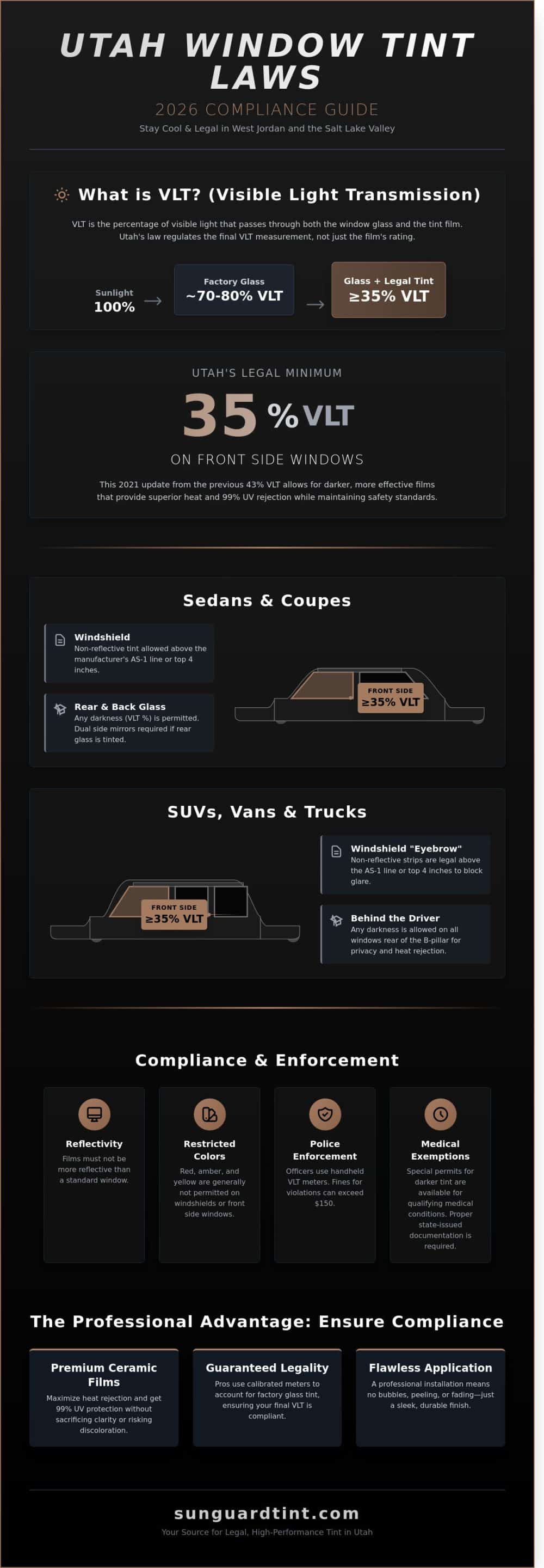
Visible Light Transmission, or VLT, is the mathematical measurement of how much light passes through your vehicle’s glass. It’s a critical metric because glass isn’t naturally 100% clear. Most automotive manufacturers produce side windows with a factory VLT of 70% to 80% to reduce glare and heat. VLT is the total light transmitted through both the window film and the glass combined. If you apply a 35% film to glass that already has a 75% factory tint, the resulting net VLT will fall below the legal limit. Our technicians calculate these cumulative values to ensure your vehicle stays compliant.
The 2026 Utah Tint Standard
For the 2026 calendar year, the 35% VLT limit remains the mandatory standard for the front side windows of all passenger vehicles. This specific percentage ensures that you can see clearly during nighttime operation or in heavy snow conditions common to the Wasatch Front. Achieving a legal tint in utah requires precision during the installation process. We rely on professional, calibrated tint meters to verify the final light transmission on every window we treat. Accuracy is vital because law enforcement officers use similar handheld meters during inspections. A variance of even 2% can result in a equipment violation and a fine that often exceeds $130. Relying on the Sun Guard standard of quality ensures your vehicle looks sleek while meeting every technical requirement of the law.
Legal Tint Limits for Sedans, SUVs, and Vans in the Salt Lake Valley
Understanding the specifics of legal tint in utah is vital for West Jordan drivers who want to avoid fix-it tickets while protecting their vehicle’s interior. Utah Code 41-6a-1635 sets the rigorous standard for how much light must pass through your glass. These regulations balance your need for thermal protection with the visibility requirements of local law enforcement. Staying within these boundaries ensures your vehicle remains a shield against the elements without attracting unwanted legal attention.
Sedan and Coupe Regulations
Passenger cars must adhere to a 35% Visible Light Transmission (VLT) limit on the front side windows. This means the film and glass combined must allow at least 35% of ambient light to pass through. It’s a critical safety measure for night driving on dimly lit suburban streets. While some jurisdictions across the country impose stricter limits on the rear of sedans, Utah is more accommodating. For the rear side windows and the back windshield, you can choose any level of darkness. You could install a 5% VLT film to shield rear passengers from 99% of harmful UV rays. If you choose a tint darker than 35% for the rear glass, your sedan must have functional side mirrors on both the left and right sides to maintain a safe field of view.
SUV, Van, and Truck Specifications
The 35% VLT limit remains mandatory for the front side windows of SUVs, vans, and trucks. However, larger vehicles are categorized as multi-purpose vehicles (MPVs), which grants more flexibility for the rear glass. You can apply any darkness to the windows behind the driver. Many Salt Lake Valley owners choose high-performance ceramic films to match factory privacy glass, which usually rests between 15% and 22% VLT. This creates a seamless, sleek aesthetic while maximizing infrared heat rejection.
For high-clearance trucks, windshield “eyebrows” are a practical way to block the blinding glare of the setting sun over the Oquirrh Mountains. These strips are legal as long as they stay above the manufacturer’s AS-1 line or within the top 4 inches of the windshield, whichever is lower. Ensuring your film meets the Sun Guard standard of optical clarity guarantees that your style never compromises your safety. Our technicians use precision meters to verify that every installation stays within the 3% variance often allowed by local inspectors, providing you with total peace of mind on the road.
Beyond Darkness: Reflection, Color, and Tinting Restrictions in Utah
Utah law goes deeper than just the percentage of light passing through your glass. Utah Code 41-6a-1635 explicitly prohibits window treatments that create a mirrored or metallic appearance. This regulation ensures that your vehicle doesn’t become a safety hazard by reflecting intense sunlight or high beams into the eyes of other West Jordan drivers. Achieving a legal tint in utah requires a sophisticated balance between high-performance heat rejection and strict legal compliance.
Reflectivity and Glare Reduction
Utah’s “no metallic appearance” rule exists to prevent dangerous glare on the road. Mirrored films reflect light rather than absorbing it; this can temporarily blind surrounding motorists during the high-noon sun on 7800 South. High-quality ceramic films provide a superior alternative for those seeking comfort. Unlike older metallic films that interfere with GPS signals and create a distracting, shiny finish, modern nano-ceramic technology offers up to 99% UV protection and 80% infrared heat rejection without the reflective side effects. You get the temperature control you need while following the legal tint in utah standards that keep our roads safe.
Restricted Colors and Aesthetics
The state maintains a strict ban on specific film colors for passenger vehicles. You cannot apply red, yellow, or amber tints to any window. These specific hues are reserved for emergency vehicles and traffic signaling; using them on a personal car can confuse other drivers and delay signal recognition times. The Sun Guard standard focuses on neutral shades like charcoal, smoke, and deep black. These options maintain high optical clarity, ensuring you see the road clearly while your vehicle maintains a sleek, professional look. We prioritize films that enhance your car’s aesthetic without compromising the driver’s ability to distinguish traffic lights or brake lamps.
- Prohibited Finishes: Red, Amber, Yellow, and any mirrored or “one-way” glass effects.
- Permitted Aesthetics: Neutral tones that maintain a non-reflective, factory-style appearance.
- Security Films: Specialized clear security films are fully legal and provide an added layer of protection against smash-and-grab thefts by reinforcing the glass integrity.
- Optical Clarity: Legal films must not distort the driver’s view of the horizon or essential road signs.
Choosing the right film is about more than just looking good. It’s about protecting what matters. By selecting non-reflective, neutral-colored ceramics, you ensure your vehicle stays cool and looks premium without attracting unwanted attention from law enforcement. We focus on the science of the film to provide peace of mind for every West Jordan driver.
Compliance, Medical Exemptions, and Utah Highway Patrol Enforcement
Utah Highway Patrol (UHP) and West Jordan police officers utilize precision tools to maintain road safety and visibility standards. They typically use handheld tint meters, such as the Laser Labs Model 200, which slide over the top of a rolled-down window to measure Visible Light Transmission (VLT). If your film measures below the 35% threshold for front side windows, you face potential citations. Officers focus on these measurements to ensure they can maintain eye contact with drivers, which is a critical safety factor during traffic interactions.
The Medical Exemption Process in Utah
For drivers with specific health needs, Utah Code 41-6a-1635 provides a pathway to install darker film than usually allowed. Conditions like Systemic Lupus Erythematosus, porphyria, or extreme photosensitivity qualify for this variance. You must carry a written statement from a licensed Utah physician that specifies the medical necessity and the required VLT level. This documentation ensures you maintain legal tint in utah while protecting your health. You’re required to display a small, identifiable sticker or keep the permit in your glove box to present during any enforcement contact.
Enforcement in West Jordan and Salt Lake City
Local enforcement remains rigorous across the Salt Lake Valley. During a traffic stop, expect the officer to test multiple windows if the film appears excessively dark. If your tint is non-compliant, you’ll likely receive a “fix-it” ticket. This mandate requires you to remove the illegal film and show proof of compliance to the court within 14 days to avoid a fine that often reaches $130 or more. Utah law requires a certificate of compliance to be kept in the vehicle if requested by an officer.
While Utah eliminated general safety inspections for most passenger vehicles on January 1, 2018, law enforcement still monitors vehicle equipment standards daily. Illegal tint remains a primary reason for being pulled over, as it serves as a “primary offense” in many jurisdictions. Shield your investment and your driving record by choosing high-performance, compliant films from the start. Our team ensures every installation meets the legal tint in utah standards to give you total peace of mind on the road.
Don’t risk fines or the hassle of fix-it tickets. Consult with our experts at Sun Guard Tint to find the perfect balance of protection and legal compliance.
Protecting Your Vehicle with Legal, High-Performance Tint at Sun Guard Tint
Professional installation is the only reliable way to guarantee that your vehicle meets the 35% VLT requirement mandated by state law. Many off-the-shelf DIY kits or low-tier shops use films that vary in density, often falling 2% or 3% below the legal limit once applied to factory-tinted glass. At Sun Guard, we utilize precision-grade digital light meters to verify every window. This ensures your vehicle remains within the strict boundaries of legal tint in utah, preventing the headache of failed safety inspections or costly citations from local law enforcement.
We approach every project with the Expert Guardian philosophy. This means we prioritize the long-term integrity of your vehicle’s interior and the safety of its occupants. Our team doesn’t just slap film on glass; we engineer a shield. By choosing our high-performance carbon or ceramic options, you’re investing in a product that maintains its optical clarity for years. It’s a sophisticated balance where sleek, high-end aesthetics meet the rugged durability required for the West Jordan climate.
Why West Jordan Drivers Trust Sun Guard
Our reputation is built on 21 years of field experience specifically tailored to Utah’s automotive regulations. We understand the nuances of the 2026 standards and how they impact different vehicle classes. When you visit our West Jordan facility at 8832 S Redwood Rd, you’re accessing a level of craftsmanship that eliminates common industry failures. Before scheduling your appointment, reviewing our checklist for selecting qualified window tint installers in West Jordan and Salt Lake City can help you ask the right questions and verify credentials. Our specialized in-shop process ensures:
- Zero bubbling or peeling, even under intense high-altitude sun exposure.
- Exact compliance with legal tint in utah to avoid “fix-it” tickets.
- A seamless, factory-finish look that enhances vehicle resale value.
- Direct consultations to help you choose the right shade for your lifestyle.
Ceramic Film: The Ultimate Shield
Ceramic film represents the pinnacle of window film technology. It offers maximum heat rejection without the need for dangerously dark shades that might attract legal scrutiny. These films are non-conductive and won’t interfere with your GPS, cellular signals, or keyless entry systems. By blocking 99% of harmful UV rays, our ceramic line prevents your dashboard from cracking and your upholstery from fading over time. It’s a proactive investment in your property’s longevity. For a comprehensive understanding of how different automotive window tint film options perform in West Jordan’s high-altitude environment, you can request a quote today to experience the Sun Guard standard of quality and discover how premium protection transforms your daily commute.
Drive with Confidence and Compliance on Utah Roads
Navigating the 2026 VLT standards ensures your vehicle remains both stylish and compliant with the Utah Highway Patrol’s latest enforcement protocols. Staying within the 35% light transmittance limit for front side windows protects you from unnecessary fines while maintaining optimal visibility during night drives through the Salt Lake Valley. Choosing a high-performance film isn’t just about aesthetics; it’s a technical commitment to shielding your interior from 99% of harmful UV rays and reducing solar heat gain. At Sun Guard Tint, we’ve spent over 20 years perfecting the balance between premium style and strict adherence to legal tint in utah.
Our West Jordan facility specializes in the precision installation of advanced ceramic heat-rejection films that outperform standard carbon options. We guarantee that every project meets the Sun Guard standard of quality, providing you with long-term durability and peace of mind. Don’t leave your vehicle’s protection to chance or unverified shops. Trust our two decades of local expertise to keep your car cool, private, and fully street legal. For those considering comprehensive protection for both their vehicles and homes, our complete window tinting Salt Lake City guide covers everything from residential applications to commercial solutions that address the unique challenges of high-altitude UV exposure.
Get a Professional, Legal Tint Quote from Sun Guard Tint
Your journey toward a cooler, more protected drive starts with an expert consultation today.
Frequently Asked Questions
Is 35% tint legal in Utah for front windows?
Yes, 35% VLT is the minimum legal limit for front side windows under Utah Code 41-6a-1635. This ensures you maintain clear visibility of your side mirrors while benefiting from significant UV protection. If your film measures lower than 35% on a professional light meter, you risk a citation. Our technicians use calibrated equipment to ensure your vehicle stays within these specific state boundaries.
Can I tint my entire windshield in Utah for heat protection?
No, you can’t tint your entire windshield in Utah, as state law restricts film to the top 4 inches of the glass or above the AS-1 line. However, you’re allowed to apply a clear, non-reflective ceramic film with a VLT of 70% or higher if you need total heat rejection. Most West Jordan drivers choose a 4 inch dark strip to block the afternoon sun without obstructing their primary field of vision.
What is the fine for illegal window tint in Salt Lake City?
An illegal tint violation in Salt Lake City typically results in a fix-it ticket with a base fine ranging from $50 to $110. If you don’t remove the illegal film within 14 days, court fees and additional penalties can push the total cost above $150. Investing in legal tint in utah from the start prevents these unnecessary expenses and keeps your driving record clean.
Does Utah allow “limo tint” on the back windows of a truck?
Yes, Utah law allows any darkness level, including 5% limo tint, on the rear side and back windows of trucks, SUVs, and vans. This provides the ultimate level of privacy and infrared heat rejection for your passengers and equipment. While the front windows must stay at 35%, you can go as dark as you’d like on the back half of these specific vehicle types to shield your interior from the sun.
How do I get a medical waiver for darker window tint in Utah?
You must have a licensed physician complete Utah State Tax Commission Form TC-817 to obtain a medical waiver for darker tint. This document certifies that a driver or regular passenger has a condition like lupus or extreme light sensitivity that requires extra shielding. Once the state approves your application, you’ll receive a certificate that you must keep in your glovebox to show officers during a stop.
Will my car fail a Utah safety inspection if the tint is too dark?
Since January 1, 2018, Utah no longer requires safety inspections for most passenger vehicle registrations, so you won’t fail an annual test. However, police officers still use portable meters to enforce the 35% VLT limit during routine traffic stops. Maintaining legal tint in utah is the only way to avoid mandatory removal orders that force you to strip away your investment and pay a fine.
Are mirrored or reflective tints legal in West Jordan?
Mirrored or metallic tints are illegal if they reflect more than 35% of light on any window. West Jordan drivers should avoid “chrome” or “mirror” finishes because they create dangerous glare for other motorists on the road. We recommend premium ceramic films that offer high heat rejection with a sleek, matte appearance. These products provide the protection you need without the legal risks associated with reflective surfaces.
What is the AS-1 line on a windshield and why does it matter for tinting?
The AS-1 line is a small manufacturer’s mark etched into the glass, typically located 4 to 6 inches below the top of the windshield. It marks the legal limit for how far down a sun strip can extend before it interferes with the driver’s line of sight. Utah law is very strict about this boundary. Placing your tint above this line ensures you stay compliant while effectively blocking the harsh glare of the high-altitude sun.