
The lower upfront option isn’t automatically the better long-term value. When weighing the cost of blinds vs window film, compare what each option needs to do on your Utah windows, how you use each room, and how much upkeep you’re comfortable with over time.
Blinds and residential window film solve different problems. Blinds offer adjustable light control and privacy, while film is applied to the glass and can help manage glare and UV exposure without covering the view. Neither suits every window. Choosing by purchase cost alone can leave an important comfort or privacy need unmet.
This comparison looks beyond the initial project expense to ongoing care, everyday comfort, and the kind of privacy each option provides. You’ll learn where blinds excel, what film can contribute, and when combining the two may make sense. Start with the priorities for each window to make a more confident choice for your home.
Key Takeaways
- Compare the cost of blinds vs window film by looking beyond the initial project expense to upkeep and the features you’ll actually use.
- Blinds offer adjustable light and privacy, while window film stays on the glass and serves different comfort and view priorities.
- Match each option to the room’s needs, including privacy, glare, décor, and whether adjustable light control matters most.
- Make a fair cost comparison by using the same windows, goals, and project scope, and accounting for products, measurements, installation, and care.
- Consider a combination when one solution alone doesn’t meet both your need for ongoing window protection and adjustable privacy.
Cost of Blinds vs. Window Film: What Are You Comparing?
Blinds and window film both change how a room feels, but they work in different ways. Blinds are window coverings with adjustable slats or panels that can be opened, angled, or closed for light control and privacy. The range of types of window blinds includes options with different materials and operating styles. Professionally installed window film, by contrast, is applied to suitable glass surfaces. The purpose depends on the film selected. It may help address glare or reduce UV exposure while leaving the window uncovered.
That distinction matters when evaluating the cost of blinds vs window film. Look beyond the initial project expense and consider the care each option may require, along with the value of features you’ll use every day. Adjustable privacy may be essential in a bedroom, while a clearer view or less glare may matter more in a living area. Neither choice is automatically less expensive or better for every window.
What does the cost of blinds usually include?
A blinds project may involve choosing products, measuring windows, and arranging installation. Material, operating style, customization, and the number and dimensions of the windows all affect the project scope. A simple covering and a customized option can involve different products and requirements, so compare similar choices across the same windows.
Plan for ongoing care, too. Blinds may need regular dusting or cleaning, and repairs or replacement can depend on the product and how it’s used. These future needs are part of the ownership picture, although they can’t be predicted from the initial product selection alone.
What does a window film project involve?
A film project starts by matching the application to the homeowner’s goals and the glass. Professional installation involves applying film to the glass surface. The number of windows, their dimensions, the film selected, and the project scope all shape the estimate. Comparing the same windows and priorities keeps the evaluation grounded in your home rather than broad cost assumptions.
Sun Guard Tint provides residential window film installation for homeowners seeking a glass-applied option. As with blinds, the right fit depends on the specific window and the job it needs to do. Film and blinds can also serve different purposes in the same home, so you don’t have to choose one solution for every room.
How Blinds and Window Film Affect Comfort, Light, and Upkeep
Comfort depends on how you want each window to behave throughout the day. Blinds can be tilted, raised, or closed as conditions change. Window film stays applied to the glass, so it doesn’t provide adjustable coverage. Depending on the film and window, it may help reduce glare or UV exposure while keeping the view more open. Purdue University Extension discusses both blinds and reflective films as approaches to improving window efficiency.
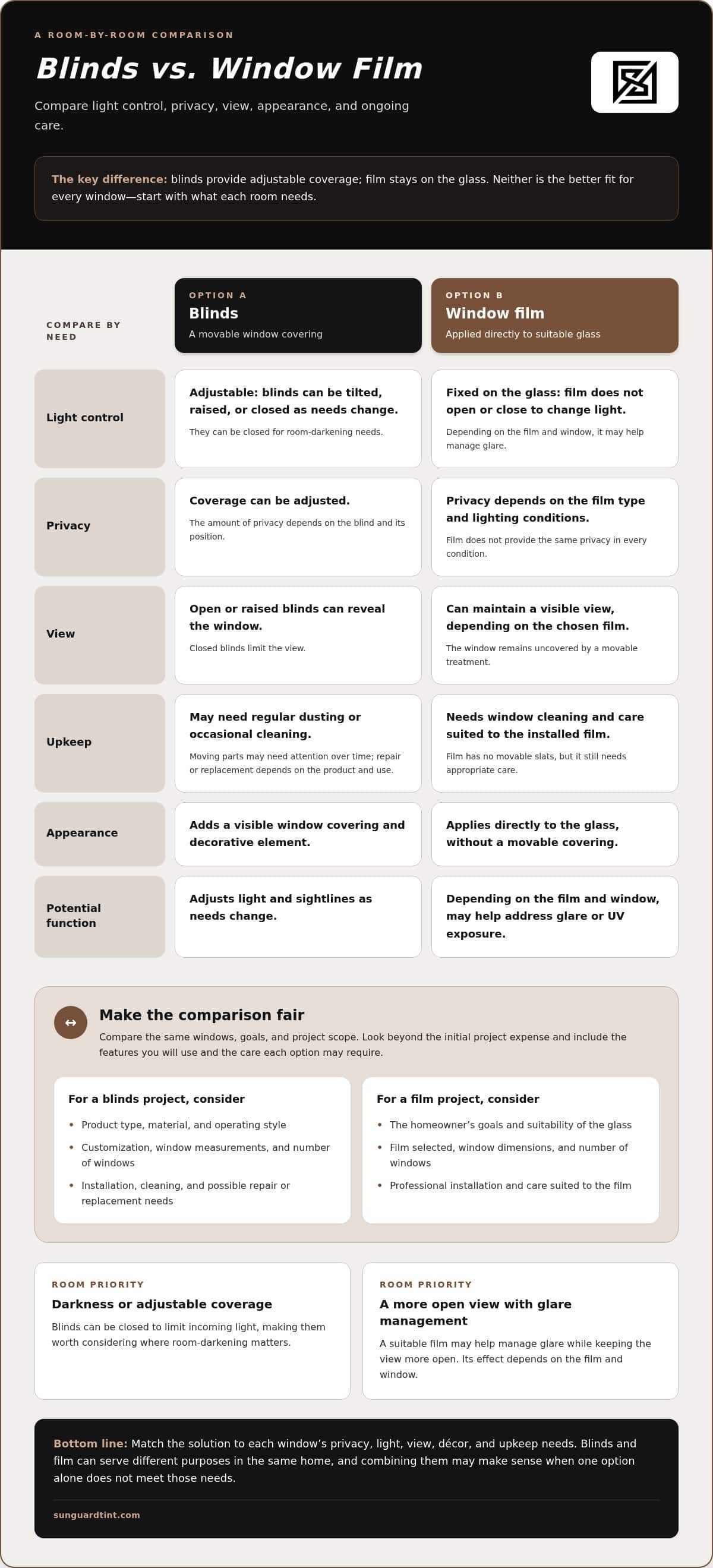
| Consideration | Blinds | Window film |
|---|---|---|
| Light control | Adjustable; can be closed for room-darkening needs. | Remains on the glass and doesn’t open or close to change light. |
| Privacy | Coverage can be adjusted, though the amount depends on the blind and its position. | Privacy depends on the film type and lighting conditions; it isn’t universal. |
| View | Open or raised blinds can reveal the window; closed blinds limit the view. | Can maintain a visible view, depending on the chosen film. |
| Cleaning | May need dusting and occasional cleaning. | Needs window cleaning and care suited to the installed film. |
| Appearance | Adds a visible window covering and decorative element. | Applies directly to the glass, without a movable covering. |
| Potential function | Adjusts light and sightlines as needs change. | May address glare or UV exposure, depending on the film and window. |
Which option gives you more control over light and privacy?
For a bedroom where darkness matters, blinds can be closed to limit incoming light. In a living space where you want to retain a view but manage glare, a suitable film may be worth considering. Privacy needs vary, too. A film’s effect depends on its type and the lighting on either side of the window, so don’t assume every film provides the same privacy in every condition.
Compare options room by room. Consider the view you want, how much light you need to manage, and whether you’ll adjust coverage during the day. Product labels alone won’t tell you which option fits your routine.
How do maintenance and long-term value compare?
Blinds may collect dust, and their moving parts could need attention over time. Film has no movable slats, but it still needs appropriate window cleaning and care. Either option may eventually require repair or replacement, depending on the product and how it’s used.
Include upkeep in the value comparison alongside the initial project scope. The better fit is the one whose benefits justify its care over time. Neither blinds nor film guarantees lower energy bills; results depend on the product, window, and home. For homeowners weighing film to address glare or UV exposure, residential window film installation is one professionally installed option to consider.
Blinds vs. Window Film: Which Is the Better Fit for Each Room?
The best choice depends on the job each window needs to do. A sunny living room, a bedroom where darkness matters, and a bathroom where privacy is central may call for different solutions. In Utah homes, consider each window’s orientation and exposure alongside how the room is used. There’s no single winner for every space.
| Room or priority | Blinds may suit you if… | Window film may suit you if… |
|---|---|---|
| Living area | You want to adjust light, sightlines, and the window’s appearance as the day changes. | You want a less obstructed view and are addressing glare or UV exposure with an appropriate film. |
| Bedroom | Adjustable coverage or room-darkening is a key priority. | You want a consistent glass appearance, but don’t need a movable covering for darkness or privacy. |
| Media room | You want to close or adjust the covering to manage incoming light for viewing. | You want to address a window concern while keeping the glass uncovered, recognizing that film doesn’t provide adjustable coverage. |
| Room with strong privacy needs | You prefer to change coverage depending on the time of day or activity. | You’ve selected a film suited to your privacy goal and understand that performance depends on film type and lighting conditions. |
When might blinds be the more practical choice?
Blinds are a practical fit when adjustable coverage is central to how you use a room. You can change their position for daylight, privacy, or a darker setting, and their materials and appearance can contribute to the interior style. If you regularly adjust a window covering as daylight shifts, that flexibility may be more useful than a solution that stays on the glass. Blinds don’t provide the same glass-applied function as film.
When might professionally installed window film suit the room?
Film may suit a space where you want to preserve a less obstructed view or keep the glass appearance consistent. The right application depends on the window and your goal. If you’re concerned about glare or UV exposure, consider a film selected for that purpose, without assuming identical results across products or windows. Film won’t replace blinds where you need adjustable privacy or room darkening.
Sun Guard Tint’s residential window film service provides a professionally installed option for suitable windows. For each room, weigh the view you want, the light you need to control, privacy, décor, and how you use the space. Those priorities put the cost of blinds vs window film in practical context: the stronger value is the option that fits the window’s role, not a universal product winner.
How to Compare Project Costs Without Relying on Guesswork
A useful comparison starts with equivalent goals, not broad assumptions about which option is cheaper. If you’re considering blinds for privacy and adjustable light, but film for glare or UV exposure, the options aren’t addressing exactly the same needs. Write down the priorities for each window first, then compare the project scope and ongoing care involved with each solution.
Use this process to keep the cost of blinds vs window film comparison grounded in details you can evaluate:
- Match the windows. Compare the same rooms and windows for each option. Note their dimensions and the purpose of each room so the comparison reflects equivalent coverage.
- Define the goal. Record whether the priority is privacy, room darkening, a clearer view, glare reduction, or another specific comfort concern.
- List what’s included. For each project, identify the selected product or film application, measurements, installation, and stated care requirements. Differences in scope affect how meaningful a comparison is.
- Separate known expenses from assumptions. Keep the initial project expense distinct from possible future savings, replacement timing, or repair needs. Without reliable information about the home and products, a payback calculation can create a false sense of certainty.
- Review the window-specific fit. Consider each window’s exposure, glass area, room use, and household routines. A solution that suits one room may not address another room’s needs.
What should a fair comparison include?
Use the same scope on both sides: the same windows, clearly stated product choices, measurements, installation requirements, and care expectations. If one option covers more windows or includes different features, account for that rather than treating the totals as directly comparable. Keep future savings and replacement frequency separate unless you have reliable, project-specific information to support those assumptions.
How can Utah homeowners account for window-by-window differences?
Exposure, room purpose, glass area, and daily routines can vary across a single home. One window may need adjustable privacy, while another may be a source of glare where maintaining the view matters. A professional assessment can help match a residential film application to the home’s glass and your goals, without relying on broad assumptions.
A tailored residential window film estimate reflects the home, selected film, and project scope, rather than a universal figure. Explore Sun Guard Tint’s residential window film service to see how professionally installed film may fit your comparison. A clear, window-by-window scope makes it easier to weigh what each option includes and how well it meets your priorities.
Choosing Between Blinds and Window Film for Your Utah Home
There isn’t one right answer for every window. Blinds provide adjustable coverage, which can be valuable when privacy or room darkening is a priority. Window film stays applied to the glass and serves different goals, such as addressing glare or UV exposure while keeping the window less obstructed. The better long-term fit depends on what you need each window to do and the care you’re comfortable maintaining.
A simple decision framework for homeowners
Start with your main priority, then identify which windows share it. A bedroom may call for adjustable coverage, while a living space may call for a clear view and glare management. Different windows may suit different solutions, and a combination can make sense when one option alone doesn’t meet a room’s needs.
- Privacy: Do you need coverage you can adjust, or a film suited to a specific privacy goal?
- Light: Is changing incoming light throughout the day important, or is a consistent glass-applied solution a better fit?
- View: Do you want a movable covering, or would you rather keep the window less obstructed?
- Upkeep: Have you considered routine cleaning and possible future repair or replacement?
- Appearance: Does the room call for a visible window treatment or a consistent look on the glass?
- Project scope: Are you comparing the same windows, goals, products, and installation needs?
Compare project scope on equivalent terms, and keep initial expenses separate from hoped-for savings. Without reliable, home-specific information, savings or payback assumptions can’t establish which option offers better value.
Explore professional residential window film in the Salt Lake Valley
For homeowners considering film, Sun Guard Tint is a locally owned provider based in West Jordan, serving residential customers across the Salt Lake Valley and nearby Utah communities. With more than 20 years of industry experience, the team provides professional residential window film installation. The right application and project scope depend on the home’s windows and your goals.
Ultimately, the cost of blinds vs window film is best judged alongside function, upkeep, and the specific windows involved. If a glass-applied option aligns with your priorities, explore residential window film service details to learn about Sun Guard Tint’s professional solution. It’s a useful next step as you consider what fits your home, without assuming film is the answer for every room.
Choose the Right Fit for Your Windows
The cost of blinds vs window film makes the most sense when weighed against the job each window needs to do. Blinds offer adjustable light and privacy, while film is applied to the glass and can suit goals such as managing glare or UV exposure. Compare the same windows and project scope, and include upkeep without relying on unverified savings or replacement assumptions.
Your choice doesn’t have to be the same throughout your home. A bedroom may call for adjustable coverage, while another room may benefit from a less obstructed view. Matching each solution to your priorities can help you invest in comfort and protection where they matter most.
For homeowners considering residential window film, Sun Guard Tint is locally owned and operated in West Jordan, serving nearby Utah communities including Salt Lake City, Provo, Orem, Lehi, Payson, Spanish Fork, South Jordan, and Saratoga Springs. The company brings more than 20 years of industry experience and provides residential window film. Explore residential window film options and take the next step toward a solution tailored to your windows and goals.
Frequently Asked Questions
Is window film cheaper than blinds?
Not in every project. The cost of blinds vs window film depends on the windows involved, their dimensions, the selected products, and installation scope. Blinds may vary by material, operating style, and customization; film estimates depend on the glass and chosen application. For a fair comparison, use the same windows and goals, and account for ongoing care as well as the initial project expense.
Do blinds or window film last longer?
There’s no universal answer because longevity depends on the specific product, its installation, care, and how it’s used. Blinds may need repairs or replacement as they wear, while film may also require attention over time. Rather than assume one lasts longer, compare product-specific care information and consider how each option’s upkeep fits your expectations for those windows.
Can window film replace blinds in every room?
No. Film stays applied to the glass, so it can’t be raised, tilted, or closed like blinds. That makes blinds useful where adjustable coverage, privacy, or room darkening matters. Film may suit windows where the priority is managing glare or UV exposure while keeping a less obstructed view. Different rooms may need different solutions, and some homeowners may choose a combination.
Does window film help reduce energy costs?
Some window film applications can help address solar heat or glare, depending on the film and window. However, no option guarantees lower energy bills, and results depend on the home and its conditions. Consider film for the comfort goals it’s selected to address, rather than assuming a particular saving or payback. A project-specific assessment can help connect the application to the windows and your priorities.
Are blinds or window film better for privacy?
Blinds provide adjustable coverage, so you can change sightlines as needed. Film privacy depends on its type and lighting conditions, and it shouldn’t be assumed to provide the same privacy in every situation. Consider the room, desired view, and whether you need to adjust coverage throughout the day. For strong or changing privacy needs, that flexibility can be an important part of the decision.
How do I compare the cost of blinds and window film without exact prices?
Compare equivalent projects rather than relying on broad assumptions. Identify the same windows, dimensions, room priorities, selected products, measurements, installation scope, and stated care requirements. Keep known project expenses separate from uncertain future savings, repair needs, or replacement timing. This approach won’t predict every future cost, but it helps show what each option includes and whether its features match the way you use the space.
Is window film a good option for homes in Utah?
It can be suitable for Utah homeowners whose priorities include managing glare or UV exposure while maintaining a view, depending on the film and window. The right fit varies by room, glass, and household needs, so it won’t replace blinds in every situation. Sun Guard Tint provides residential window film from West Jordan to nearby communities including Salt Lake City, Provo, Orem, Lehi, Payson, Spanish Fork, South Jordan, and Saratoga Springs.

Article by
Sun Guard Tint